Well, it’s a bit difficult to narrow down what to see in Madrid on a 3 or 4-day vacation; the city has so much to offer that you wouldn’t get tired of exploring it even with much more time!
However, it wouldn’t be a good guide if I just told you that, so today let’s discover in detail a series of attractions you can see in Madrid in a few days, with an estimate of the indicative time needed to visit each one, also leaving you with ideas for other possible things to see in Madrid if you have more days available! 🙂
Map of attractions to see in Madrid
Let’s start as always with the reference map to check while reading (and while visiting the city) and then begin with the list of things to see in Madrid! 🙂
The green pins indicate parks, the brown ones museums, the yellow ones covered markets, and the blue ones the attractions to visit in Madrid, which we’ll see as we go through the guide. What’s certain is that you’ll need accommodation in a convenient location to visit these places, so also take a look at the most practical areas to stay in Madrid.
Palacio de Cibeles
Time: less than an hour

The Palacio de Cibeles, in its beauty, might be for many the building that, by capturing your attention, will greet your arrival in Madrid. This is because it’s located near two of the busiest bus/train stops and stations where you might stop when arriving from the airport (Cibeles and Recoletos).
You may like: How to get from Madrid airport to the center
The Palacio de Cibeles, an excellent postcard for your first photos, houses the post office headquarters but also has some little-known public spaces, like a bar and a panoramic terrace from which to see the city from above. Access costs 3€.
If you have some spare time, you can also take a look at the remaining palaces built on the other 3 sides of the square (yes, because even if it’s not very clear, besides being a roundabout and a bus station, this would also be a square): the Palacio de Linares, Palacio de Buenavista and the Banco de España.
Parque del Retiro
Time: from 3 hours to indefinitely
A park? Yes, an immense park (but not the largest in Madrid) right next to the city center.
Among the things to see in Madrid, you shouldn’t miss Parque del Retiro, not only for the chance to relax a bit in the shade if you’re visiting during the hot months, but also to visit the different parts of the park, which I recommend exploring by bike given its size and to enjoy it better!
You’ll go from areas with extremely well-kept gardens with hedges and “embroidered” trees like in an imperial garden, to those of a “classic” park with plenty of trees to rest under in the shade, to the wide avenues full of people strolling or playing sports, then to the Palacio de Cristal among small grottoes and ponds and finally to the Estanque del Retiro, which I’ll tell you about shortly. And all of it can be visited for free.
Palacio de Cristal
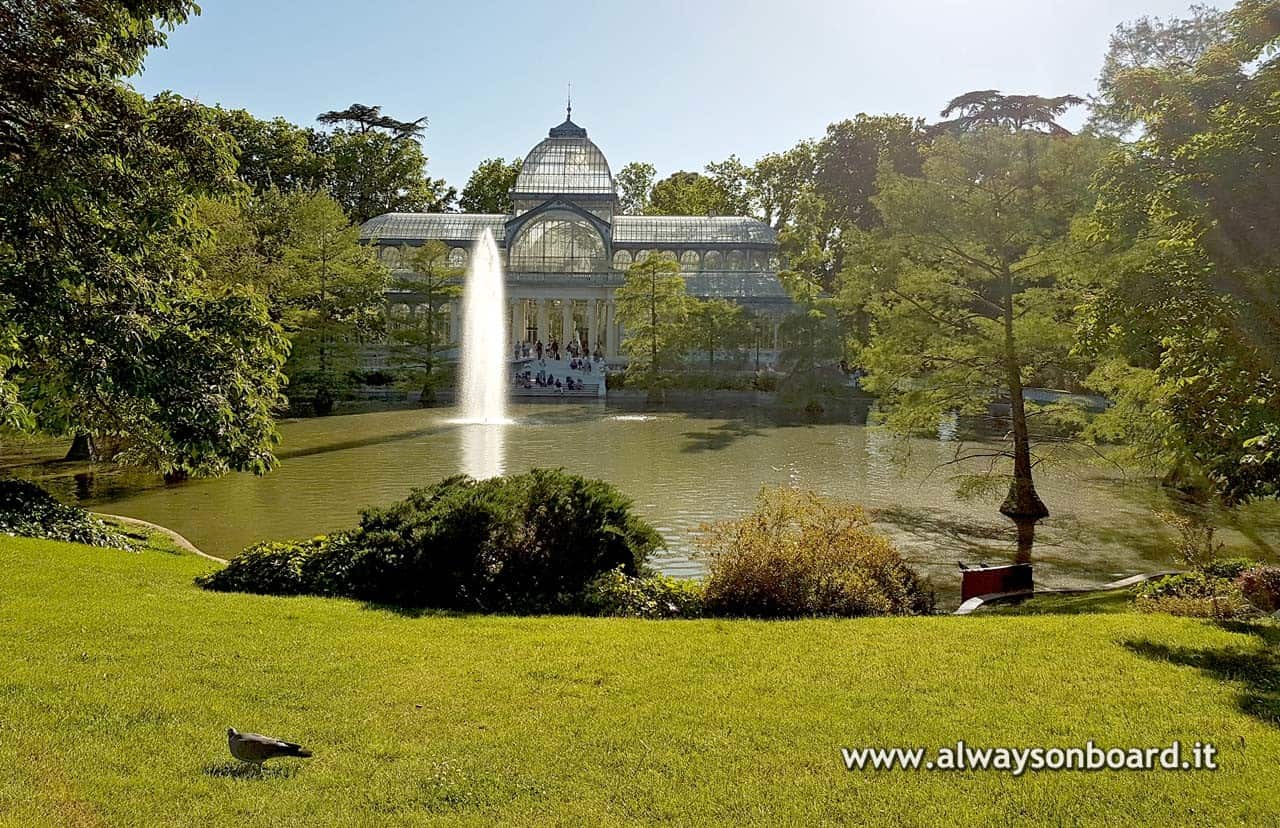
The Palacio de Cristal is a structure that strongly resembles a greenhouse, partly because of its appearance and partly because of the internal temperatures. 😆 Inside the Palacio de Cristal, there are some sculptures so white that they blend in with the visitors… how many can you count in this photo? 🙂
In front of the Palacio de Cristal, you’ll also find a small pond with a fountain, ducks, turtles, as well as small “grottoes” where you’ll surely find inspiration for some photos.
Estanque del Retiro
The Estanque del Retiro is an artificial rectangular pond located within Parque del Retiro, whose main attraction is the possibility of renting a rowboat for €6 for 45 minutes and rowing around the lake. 🙂
If you’re a couple, it’s definitely one of the most romantic gems in the city, as long as you avoid the central hours in the summer months or peak tourist days to prevent it from turning into a water bumper car ride. The best time? Sunset, without a doubt!
Madrid’s parks
After exploring this park, don’t think you’ve seen all of Madrid’s greenery.
If you have the chance to rent a bicycle (I insist, get one), a visit to some other parks is highly recommended. The most recommended ones to see in Madrid are:
- Madrid Rio: i.e., the park on the Manzanares River, marked on the map south of the city, which runs alongside the river and is very well-maintained;
- Casa de Campo: Madrid’s largest park, west of the city. You’ll hardly be able to explore this entire park even if you have an electric bike, given its size. It’s immense, also characterized by wide roads/paths that will make you feel like you’re in the countryside, and small hills in the middle of which you can truly feel at peace. In some areas, the vegetation is a bit “drier” than in the city center parks, but you’ll also find artificial ponds and the Zoo Aquarium de Madrid.
A fun fact about this park? It’s built over a section of an underground highway; - Campo del Moro: the royal garden next to the Palacio Real, which we’ll see in the guide;
- Parque del Oeste: another garden west of the city, between the Templo de Debod and the river;
- Parque de Berlin, which we’ll talk about in this guide;
- as well as many other parks, which are truly numerous in Madrid. Just zoom in on the map to see how many there are!
Prado Museum
Time: from 2 hours to infinite hours for enthusiasts
For art enthusiasts, a stop at (at least one) city museum can’t be missing from the list of things to see in Madrid. One of the largest and most renowned is the Prado Museum, located right between Parque del Retiro and the city center.
Inside, you’ll find works by Velazquez and Goya, as well as various Italian artists like Botticelli, Titian, Tintoretto, Caravaggio, and many others.
The ticket costs €15 and you can check the opening hours or buy it on the official website. Alternatively, on this page, you’ll find numerous ticket combinations, with the advantage of free cancellation. From a simple ticket, to a skip-the-line ticket, to one that includes a guided tour.
At one time, access to the museum was free during the last 2 hours of the day (i.e., from 6 PM to 8 PM). Now, unfortunately, free access has been reduced to only the last 30 minutes. Too little to visit the entire museum, but if you’ve already seen it or are just looking for a particular work, it’s a very good option for a quick visit and to save on the ticket!
List of museums in Madrid
- the Ferrocarril de Madrid Museum (railway museum),
- Museum of Anthropology
- Reina Sofia Museum (another art museum, smaller than the Prado and with free entry before closing, tickets here)
- Thyssen-Bornemisza Museum (art museum, tickets here)
- the Naval Museum
- the Museum of Romanticism
- National Archaeological Museum
- Museum of America
- Casa de la Moneda Museum (on the evolution of money)
- Museum of Illusions
- Wax Museum if you want to meet some VIPs without going to London 😉 tickets here
As you can see, when it comes to museums to visit in Madrid, you’re spoiled for choice. The ones listed above are marked on the map with brown pins.
Puerta del Sol and KM 0
Time: half an hour
Puerta del Sol is one of the most emblematic squares to see in Madrid. With its crescent shape and the statues of “el oso y el madroño” (the bear and the strawberry tree, symbols of Madrid), it also has an important meaning for all of Spain.
On this square, you’ll also find the tile that represents “kilometer zero,” from which the measurement of the distances of all roads extending radially from the capital begins. (Remember “all roads lead to Rome”? Well, some lead to Madrid instead).
Where is this tile? …I’ll let you have the fun of finding it. 😉 (Hint: look for a group of people looking at the pavement)
La Gran Via
Time: depends on your weakness for shopping
A short distance from Puerta del Sol, we then find Madrid’s Gran Via, the city’s main shopping street, where you’ll find stores of the most famous brands (but not only) for your shopping sprees.
Yes, looking at it like this, if it weren’t for the very different sky, it would look like a famous London street…
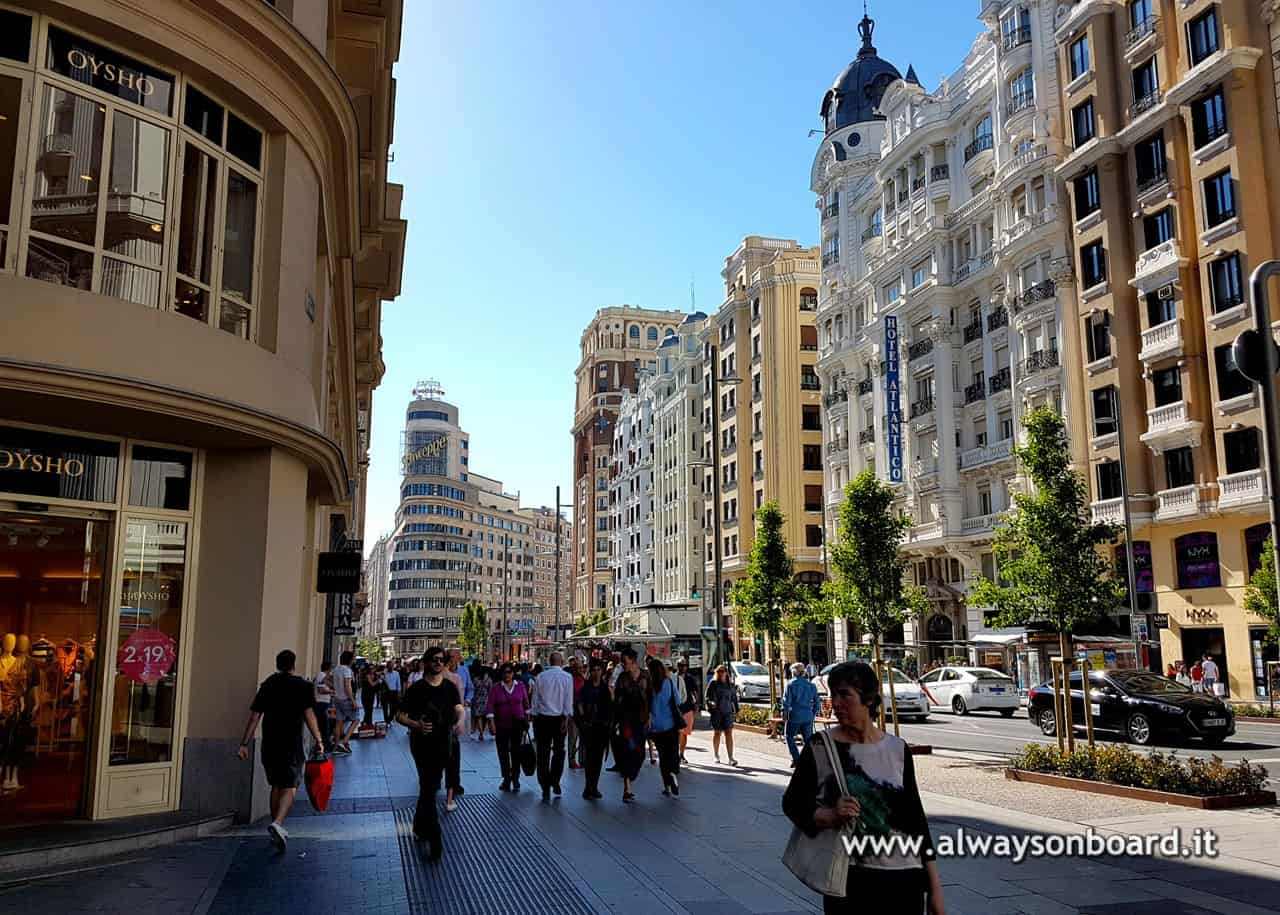
When you pass through Gran Via, don’t forget to pop into El Corte Inglès department store (which you’ll find marked on the map), where you can go up to the top floor for free and enjoy the city view from the bar’s terrace. 🙂
Plaza Mayor
Time: half an hour
Plaza Mayor is one of the symbolic squares of the Spanish capital. Its rectangular shape, surrounded by buildings once entirely made of wood, destroyed and rebuilt several times, is a meeting place as well as the venue for events and concerts, such as during the Fiera de San Isidro, the city’s patron saint.

After visiting the square and the shops under the arcades around the entire perimeter, some of which are historic, take a moment to notice a small detail: the plaques with the names of the avenues leading from the square. In addition to displaying the street name, these plaques also have an illustration, intended in the past to ensure that even those who couldn’t read could understand the street name from it.
You’ll find other such plaques around Madrid, spot as many as you can! 🙂
Restaurante Botin
Why include a restaurant in the list of things to see in Madrid? Because Restaurante Sobrino de Botin is the oldest restaurant in the world still in operation since 1725, which is why it’s in the Guinness Book of World Records.
One of its specialties is suckling pig, some of which you can even see by peeking into the kitchens.
The restaurant’s facade, though modest in size, still hints at the place’s history, while the interiors, spread over several floors, have paintings and illustrations on the walls, some with signatures of important visitors dating back a few centuries.
Going down to the basement (minding your head on the truly historic stairs) you’ll find yourself in a very respectable atmosphere. Also in the basement are the restaurant’s cellars, which hold a little secret that I won’t reveal here… but which you can discover if you visit the restaurant during a city walking tour (at the end of the guide, I’ll explain where to find them)! 🙂
The covered markets
Time: 1 hour or more if you stop for a drink or lunch
If you’ve already been to some other Spanish cities, you’ll have noticed that each of them hosts a permanent market in a covered structure, mainly selling food items that can also be consumed on site, thanks to some special stalls or a few bars for a drink with company.
Among the things to see in Madrid, these covered markets should not be forgotten, as they are even more numerous here than in other cities. For example, we find the Mercado de San Antòn in the Chueca district, Il mercado de San Miguel right next to Plaza Mayor, or the Mercado de La Paz if you’re in the Salamanca district. You’ll find them all highlighted on the map above with yellow pins.
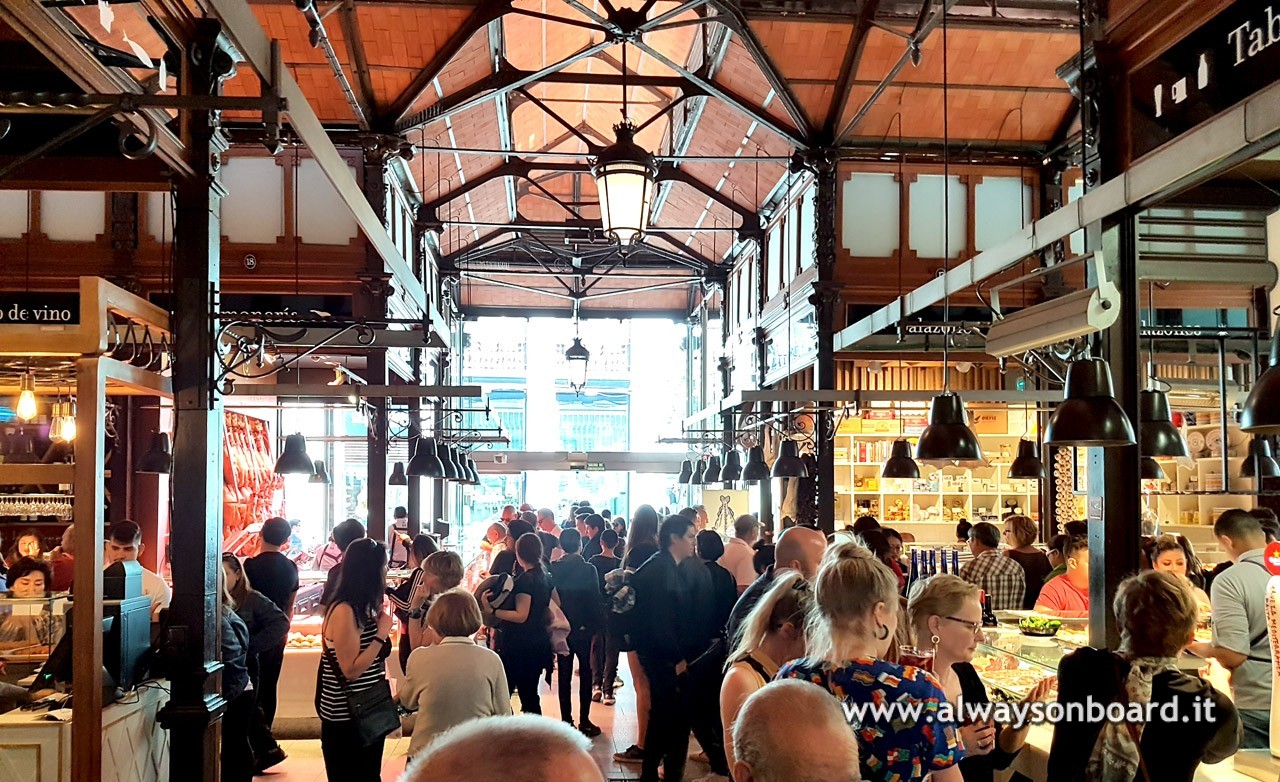
These markets represent an excellent alternative for lunch (or dinner for those that stay open in the evening) with fresh or typical local products and for a drink while you’re out on your Madrid sightseeing tour, with the advantage of not wasting time looking for a satisfactory restaurant or bar. I therefore recommend including this stop when it’s time to refuel. 🙂
A small downside is that in Madrid, the prices you find inside these markets are higher than the very affordable ones in similar markets in other Spanish cities, probably due to the high tourist influx.
Read also: Where it’s best to stay in Madrid
Mercado del Rastro
The Mercado del Rastro, unlike those just mentioned, is an open-air market to visit in Madrid every Sunday morning, roughly between 9 AM and 3 PM.
At Mercado del Rastro, in addition to the usual goods you can also find at Italian city markets, there are also stalls with second-hand or typical local products. With the possibility of bargaining.
The Royal Palace
Time: about ten minutes from the outside or several hours if you go in
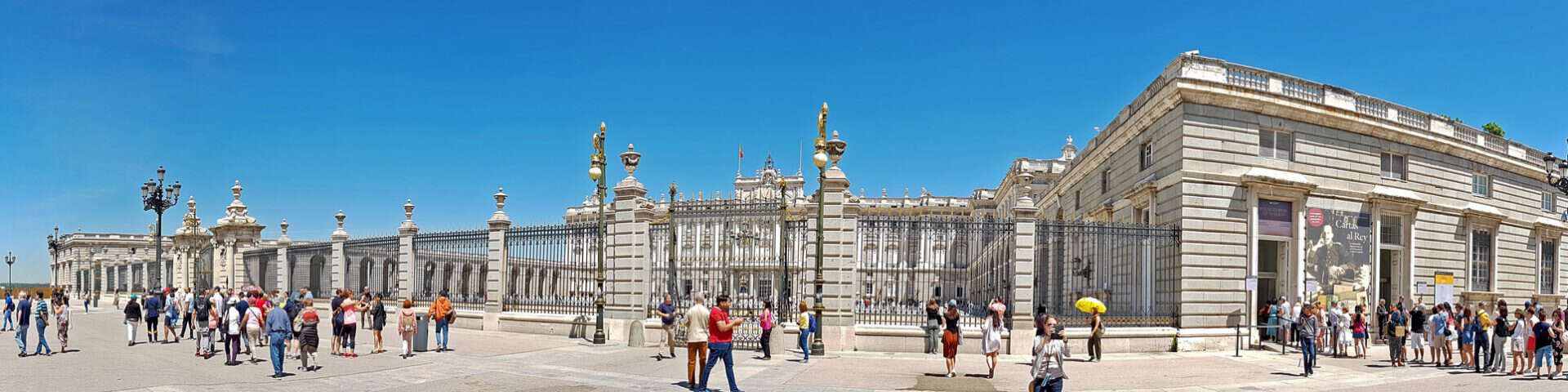
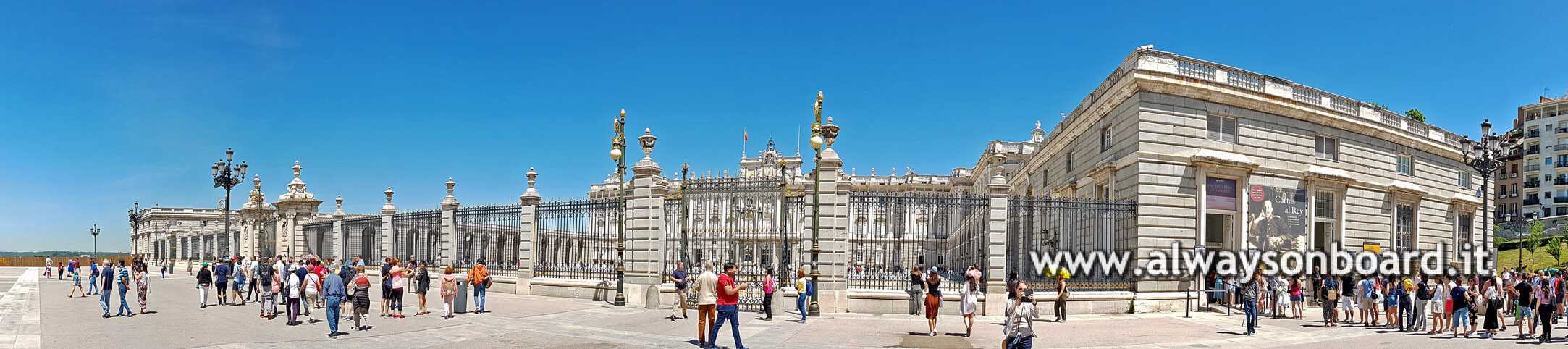
Royal Palace of Madrid is one of the most enormous and luxurious buildings you can see.
The current building is built on the ruins of the previous Muslim fortress (Alcazar), which had been converted into a Royal Palace from the time of the Christian reconquest of the city until it was destroyed by fire.
King Philip V of Spain, who ordered the construction of the current building, wanted so many rooms built that he could live in a different room of the building every day. This exaggerated request meant that the construction of the new palace took 26 years, and the king died before he could move in.
It’s possible to visit the Royal Palace of Madrid inside as well, (link to the official website) but be prepared for long queues despite the staggered entrances. Or you can book a guided tour with free cancellation.
The Royal Palace has a royal garden on a slight slope on the west side of the palace; on the east side, there’s another small park with some statues, including one dedicated to King Felipe IV; as you can see, Madrid really doesn’t lack greenery.
Finally, on the south side, overlooking the palace entrances, is the Catedral de la Almudena, a relatively recently built cathedral, behind which there’s also a crypt, which I’ll tell you about right away.
Below are some of the available ticket combinations for visiting the Royal Palace:
Crypt of the Almudena Cathedral
Time: 10 minutes
A short distance from the Royal Palace, we also find the Crypt of the Almudena Cathedral.
Open for free (you can leave a donation), it can be visited in a few minutes, and you’ll find numerous large tombs right on the floor.
Temple of Debod
Time: 10 minutes or 1-2 hours if you go inside
Another thing to see in Madrid, perhaps after the Royal Palace since they are both west of the center, is the Temple of Debod.
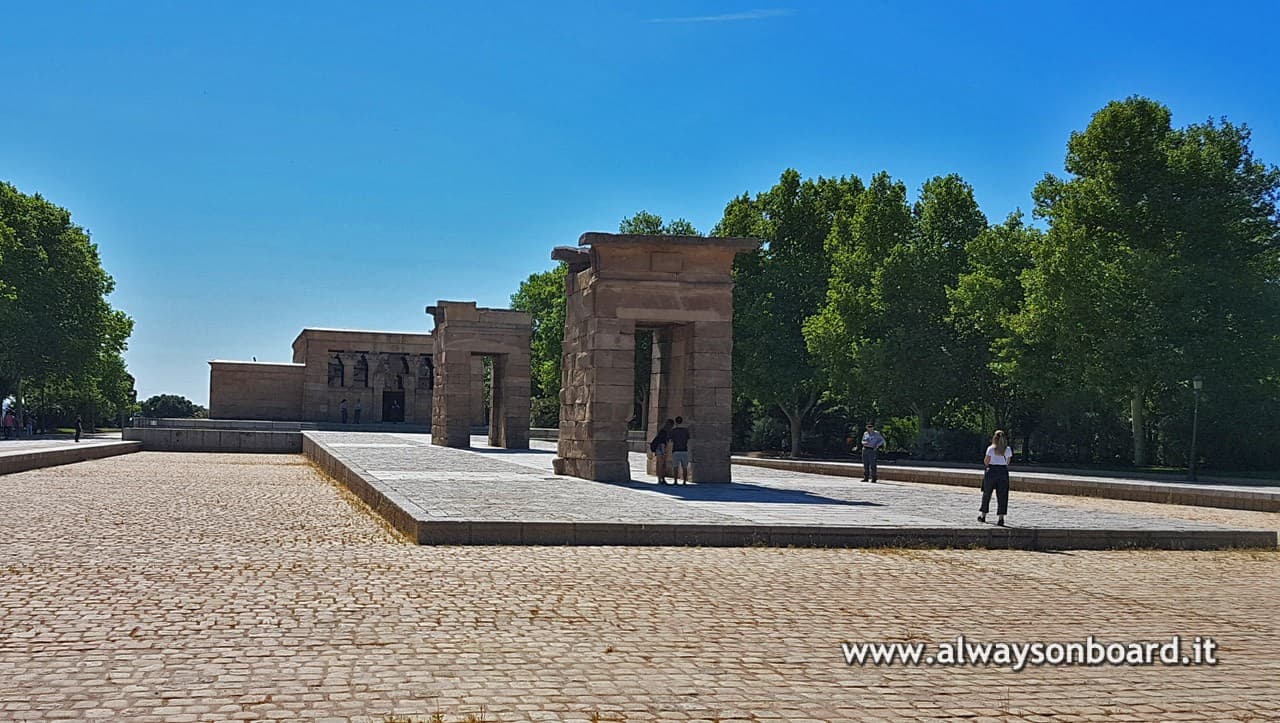
The Temple of Debod is an Egyptian temple that was gifted by Egypt to Spain in the 1960s as a thank you for the nation’s help in saving some Nubian temples.
You can visit it at sunset if you like; with an unobstructed view to the west, it could offer a beautiful play of light.
The Temple of Debod can also be visited inside; only a few people enter at a time as it’s quite small, which is why long queues often form here as well. (link to the website)
Teleférico de Madrid
Time: at least 1 hour
Tired of walking? Want to try something more exciting? Not far from the Temple of Debod, you’ll find one of the two entrances to the Teleférico de Madrid, a cable car that reaches a maximum height of 40 meters, where the view is guaranteed. 🙂
You may like: Seeing Madrid from above – all the spots
You can ride the Telefèrico for 6 euros, which travels 2.5km to take you to the heart of Casa de Campo park, the largest in the entire city of Madrid.
You can find timetables and details on the Telefèrico de Madrid website or on EsMadrid, and some videos on youtube to get an idea of the route. 🙂
Paseo de la Fama
Time: 20 minutes
Have you always dreamed of Los Angeles but budget or fate have always kept you away? Trick your friends by taking a photo at the Paseo de la Fama and making them believe you’ve been there! 🙂
Just a few steps from the Temple of Debod, make a stop along Calle de Martin de Los Heros to visit the Paseo de la Fama where you’ll find a series of stars along the sidewalk, just like in Los Angeles, bearing the names of some Spanish (or generally Latin) actors.
Between a few photos and some attempts to figure out the actors you’ve heard of, some smiles are guaranteed!
Atocha Train Station
Time: 20 minutes
It might sound strange to find a train station in the list of things to see in Madrid; yet in Spain, some train stations are real attractions (like, for example, the North Station in Valencia).
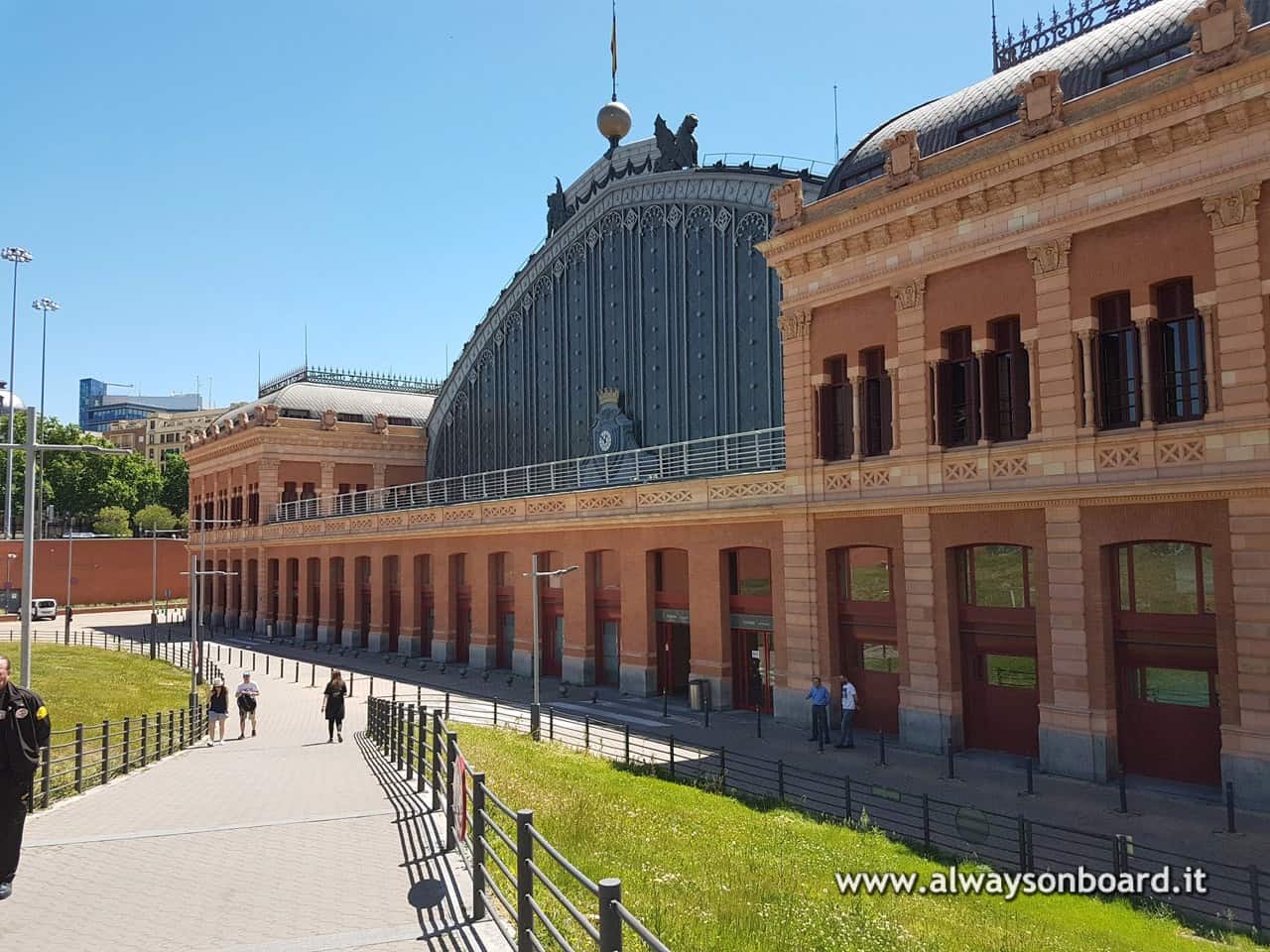
Atocha train station, one of the busiest in Madrid, from which numerous long-distance trains depart, is a like a tropical garden (or greenhouse).
It might be the first station you see if you arrive from the airport to the center by train and are staying near Atocha, or it might be the departure station for your train if you decide to visit Toledo. If neither of these is your case, you can still pop in for a walk, you won’t lose much time!
Parque de Berlin
Time: 2 hours
Moving a bit away from the center of Madrid, you can also reach Parque de Berlin.
It’s a small park a few kilometers away from the city center (you’ll definitely need to take a metro or a bicycle to get there) in the center of which, on a sort of small pond, three original pieces of the Berlin Wall are preserved.
A quick visit (journey aside) and not very demanding.
Plaza Castilla
If you’ve made it as far as Parque de Berlin, you can now make another stop in the area to see Plaza Castilla.
This modern square is characterized by a tall, pointed obelisk, as well as two “inclined” skyscrapers, for lovers of modern architecture.
Madrid Stadium “Bernabeu”
The Madrid “Santiago Bernabeu” stadium, owned by Real Madrid, is a stop that football fans will surely want to put at the top of their list of things to see in Madrid. To get in during matches, on the official website you can find ticket sales, or to visit it, here you’ll find other access combinations. Another option is also to go with a guided tour.
Not being an enthusiast of the sector, I don’t have many details to give you… but I know this won’t stop you! 😀
Toledo!
Time: half a day/a full day
Do you have a fourth day available and feel like a change of scenery? Visit Toledo!
But Toledo is a city in its own, why mention it in the list of things to see in Madrid?
Because Toledo is easily reachable by high-speed train in 30 minutes, from Atocha station (the one mentioned earlier), for a price of about 22 euros round trip. You can buy tickets (better in advance before seats run out) either online, typing Atocha as departure and Toledo as destination, or at the station ticket machine.
Toledo is a city where the word history is always in front of you; inside the walls, it feels like you’re still in the past, as so much has remained intact.
The access bridges to the city and their respective gates are truly impressive, and the city can easily be explored in half a day or a full day (assuming you don’t want to enter all the numerous churches, in which case the time would be longer).
Toledo is historically famous for sword production, and (if you don’t have to fly home) you’ll be spoiled for choice as to how many and which classic (or reproduction) swords you can buy, even at a good price, in the shops scattered throughout the center.
…the nightlife!
It might seem obvious, but one of the things to see in Madrid is precisely the nightlife.
Here, more than in other cities, I really felt the need to have some days to visit the city during the day and just as many to experience it at night (or alternatively, 36-hour days).
The many opportunities offered by Madrid’s nightlife make it truly one of the most complete you can find. From the most common bars and restaurants you find in the various squares of the center, to small clubs hidden behind soundproof doors, disco-bars or large nightclubs just outside the center with Latin, rock, or electronic themes, there are possibilities of all kinds every night of the week until dawn. And in the Chueca district, there’s no shortage of gay bars/clubs either.
Walking tour to see Madrid?
I mentioned free walking tours in this guide, so let’s spend a few more words on them now.
How a free walking tour works
More and more cities (both Spanish and non-Spanish) in recent years have been offering daily “free walking tours” that allow you to visit the city’s highlights with an accredited guide who is usually a local student.
Often, it’s not even necessary to book these walking tours; just show up at the meeting point 10 minutes before the start time. Walking tours are based on tip support, so at the end of the tour, if you enjoyed it, feel free to leave a tip for the guide who, not being paid by the association, supports themselves through them.
In my opinion, these walking tours are highly recommended for several reasons:
- The young guides are well-informed about the history and curiosities of the places they’ll take you to visit,
- they take you to certain places and tell you certain details that you would never have discovered without a guide,
- they take you to both classic/historic places and to visit alternative attractions without risking boredom,
- they allow you to visit the city’s highlights in 2-3 hours, so then you choose in the remaining days what to visit more thoroughly or what to skip, which is why I always recommend participating in one of them (whichever city you visit) on one of the first days of your stay!
Free walking tour in Madrid
Having explained how free walking tours work, if you want to participate, you’ll find at least two different companies at Puerta del Sol (marked on the map above) every morning at 11 AM.
The tour I took was with Trip Tours Madrid; to find them, just look for the people with the yellow umbrella, and then choose whether to follow the tour in English or Spanish. Alternatively, you can also find tours from other associations like Free Tours, Leaf Madrid, or others that you might randomly encounter in Madrid’s squares when you see colorful umbrellas open in broad daylight! 🙂
Now that you know everything about what to see in Madrid, don’t miss the guide to the best areas to stay in Madrid to find accommodation in an area that won’t make you waste time (and legs!) with too much travel!
Was this guide helpful? Share it with friends or follow the official Facebook page to help the site grow! 🙂
Send a Tip 😍