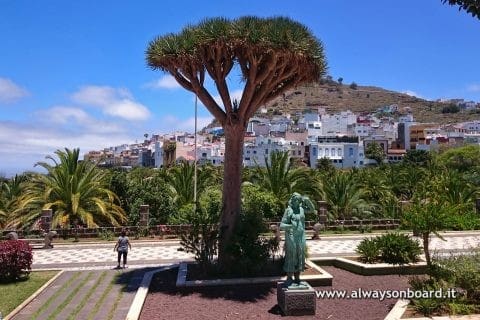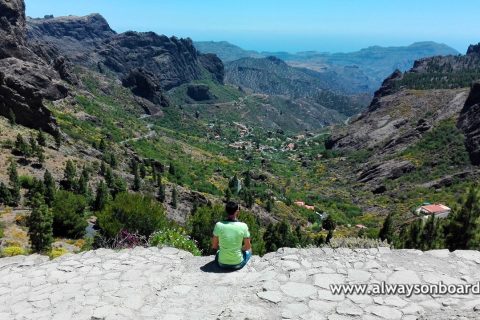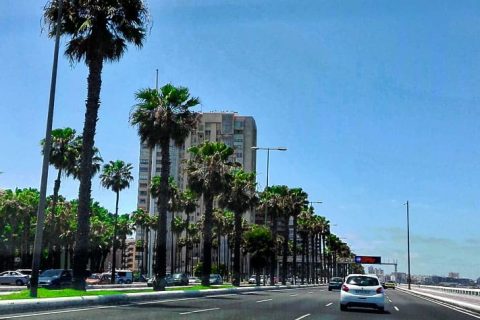
Today we’re talking about one of the largest and most populated islands of the Canary archipelago, which, with its 50km diameter, might pose a challenge when searching for the most suitable area to stay in Gran Canaria.
On this island there is no “perfect” place where you should stay and never move from. Whatever area you choose to stay in Gran Canaria, to visit the island’s attractions and landscapes a rental car is also essential, and since costs on these islands are not excessive, don’t worry about the budget; here I give you some tips about car rentals.
Where to stay in Gran Canaria – map of the best areas
Let’s start with a map to get an idea of where the best areas to stay in Gran Canaria are, which we’ll cover in the guide, marked in blue. Brown dots indicate the main nightlife and clubbing areas.
Playa del Ingles – Maspalomas
Size: Large
Pros: Abundance of services, nightlife, the Maspalomas dune park just steps away.
Cons: During high season parking takes some luck. It’s a tourist area.
The urban center of Maspalomas and in particular the area of Playa del Ingles, located in the south of the island, is the most famous area to stay in Gran Canaria.
It is an urban center built and oriented toward tourism, where you can find all types of accommodations, from luxury to budget.
There is also space far from the hustle, with its long sandy beaches stretching several kilometers from the Maspalomas dunes southward (which I’ll talk about shortly), up to the San Agustin neighborhood to the north.
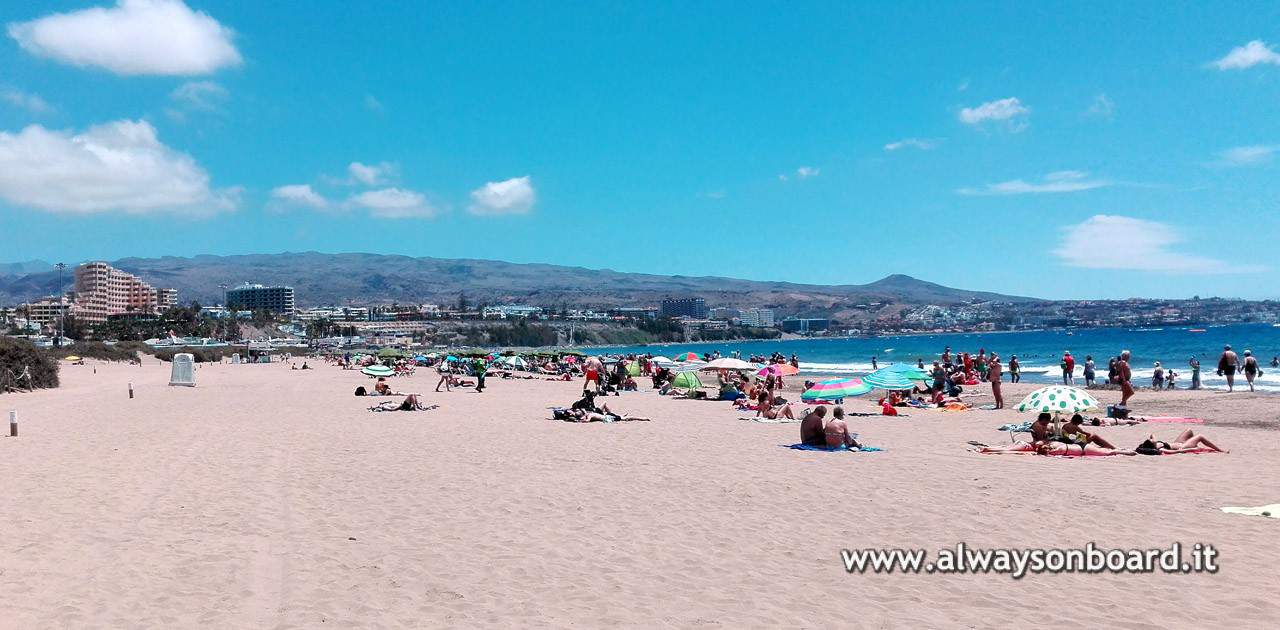
Playa del Ingles is also the top choice for staying in Gran Canaria for those seeking nightlife. Here you’ll find several areas with bars and discos, as well as the Pacha of Gran Canaria.
The nightlife is not guaranteed, as it varies a lot depending on the season. For example, during my first trip to Gran Canaria (at the beginning of June to avoid the crowds of late May when one of the world’s biggest prides is held in Maspalomas), there was practically no one in the clubs at night—not even at Pacha, where only the bartenders and PR were present. 😆
However, this tourist area also offers something interesting from a naturalistic point of view. The urban center borders the Maspalomas Dunes, a real desert several kilometers in diameter where you can see the ocean in the distance and the silent dunes all around.
Maspalomas, and particularly Playa del Ingles, is ideal for those who want all services in the area, those looking for nightlife (and despite everything, many accommodations are absolutely quiet), and those who want to frequently visit the dunes (don’t forget your hat and water!).
Some activities you may like, before going on with the article:
This area is also a good starting point for getting around by car as the highway is pretty close, letting you head north or to other key areas in the island’s southwest.
You might also be interested in: What to visit in Gran Canaria in 7 days
This area is not recommended for staying in Gran Canaria if you don’t want to be in a district essentially built for tourism or if you’re looking for more traditional and cheaper places.
- Apartamentos Las Dunas, where I also stayed: small apartments for 2–3 people with kitchen, living area and terrace, just steps from the sea in a quiet area with a pool;
- Apartamentos Las Faluas: affordable but well-kept apartments with kitchen corner and a nice pool, bar/restaurant, paid Wi-Fi;
- Hotel The Anamar Suites: 4-star hotel with apartments for up to 3 people at competitive prices, gym, restaurant and bar, paid Wi-Fi;
- Bull Escorial & SPA: 3-star hotel with SPA, wellness center, gym, free Wi-Fi and all-inclusive options;
- Bohemia Suites & SPA: 5-star property with rooms for 2, SPA, wellness center, gym and airport shuttle.
Meloneras
Size: Medium
Pros: Well-serviced and quiet area, still adjacent to the dunes, with fairly high-end accommodations more geared towards luxury;
Cons: Could be expensive; not much else to do outside of resorts and dunes.
After talking about Maspalomas, before going further we must mention the nearby area of Meloneras, which is “mirrored” because it lies on the opposite side of the Maspalomas Dunes.
Meloneras, a smaller district to stay in Gran Canaria than the previous one, is more oriented towards high-end tourism, with many 5-star accommodations, resorts, and a well-kept seafront promenade.
In Meloneras you’ll also find the Maspalomas lighthouse just a few steps from the sea, and this district, facing southwest, can offer particularly stunning sunsets, even from atop the dunes.
- IFA Faro Hotel: 4-star property with a pool and remarkable view of the lighthouse, the ocean, and the dunes, at a competitive price;
- Lopesan Baobab Resort: 5-star property immersed in a tropical garden, with African-style furnishings and a flashy outdoor pool. Babysitting service and kids’ club, restaurant, gym, rooms for up to 4 people.
- Oasis Playa Maspalomas: 2-star apartments at the edge of the neighborhood, with views of the Maspalomas dunes.
- Lopesan Villa del Conde Resort & Corallium Thalasso: 5 stars with a 1200 sqm SPA located on the seafront, panoramic gardens and pool.
Las Palmas
Size: Large
Pros: Availability of services and nightlife, a beachfront for those who don’t want to drive and another beach nearby for surfing.
Cons: It’s a busy city and colder in winter since it’s in the north.
Another area to consider for staying in Gran Canaria is the populous city of Las Palmas, “capital” of the island. In other Canary Islands like Tenerife or Fuerteventura I usually advise against staying in the capitals, but in the case of Las Palmas it’s worth considering.
In Las Palmas you can find the long sandy beach of Las Canteras, for those who want to stay in a city (or are forced to for work reasons) without missing the sea.
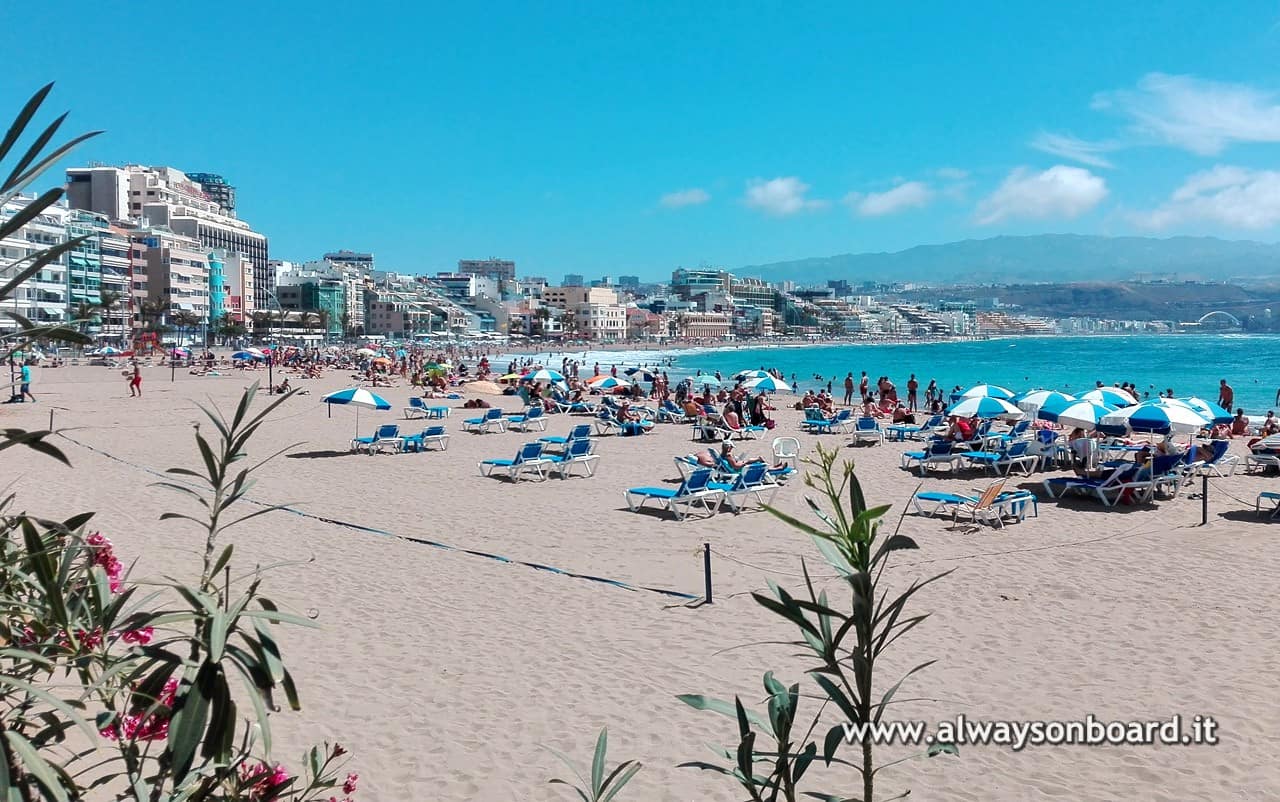
A short distance to the north, also reachable on foot, is Playa de El Confital, a wild beach perfect for those who want to surf.
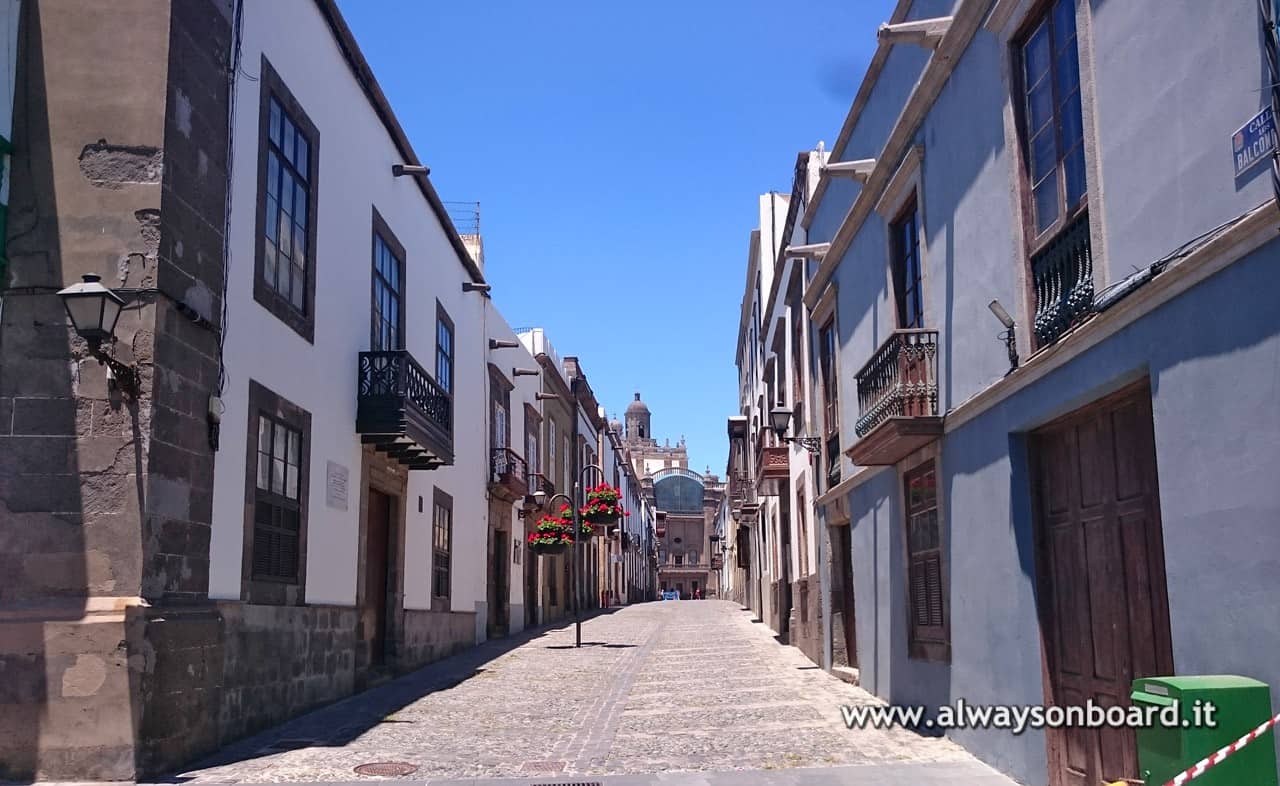
Moving away from the beaches, you can find two different faces of the city of Las Palmas just meters apart: the historic district (Vegueta) around Plaza San Agustin and Plaza Santo Domingo, characterized by colorful, charming, and quiet streets. North of the historic district, you’ll find the modern part of the city, with wide avenues full of shops and activity.
Notice the different crowd levels in two photos taken at the same time on the same day. 😀

I don’t recommend staying in Las Palmas to those escaping from a city and who don’t want to end up in another city’s depths, to those who love natural beaches, and to those traveling in winter: being on the north side, it’s more prone to bad weather.
- Suites 1478: historic district – 5-star hotel at affordable prices.
- Aminta Home: historic district – B&B with shared bathroom rooms housed in a building in typical Canarian style.
- Hotel Faycán: beach area – budget 3-star hotel but well-kept, with rooms for 2 or 3 people.
Puerto Rico
Size: Medium
Pros: Less overrun than other tourist areas, sheltered from the wind, probably the best area to stay in Gran Canaria during winter;
Cons: Less nightlife than elsewhere.
Puerto Rico is another predominantly tourist urban district (but certainly less dense than Maspalomas), located in the southwest of the island.
For those traveling in winter and looking for good weather and beach life Puerto Rico is one of the two best choices to stay in Gran Canaria, as this area in the southwest of the island is usually among the most sheltered from the wind and thus suitable for lying on the beach even in January.
The nightlife is much more limited and quiet, while for those who want the sea nearby there is the large Playa de Amadores.
Playa de Amadores is a beach that deserves separate consideration. It’s the most photographed beach on the island, the one featured on all the ads or Gran Canaria travel tours (always with enhanced colors and exaggerated saturation), as if it were the only beach on the island. Here’s a photo with real colors instead:
Although it is located in a partially artificial bay that makes the waters very calm and clear, I must say that in my opinion the heavy cement structures behind it somewhat disturb the landscape. Here’s what you would see if the photographers of those cover shots used a slightly wider frame. 😀
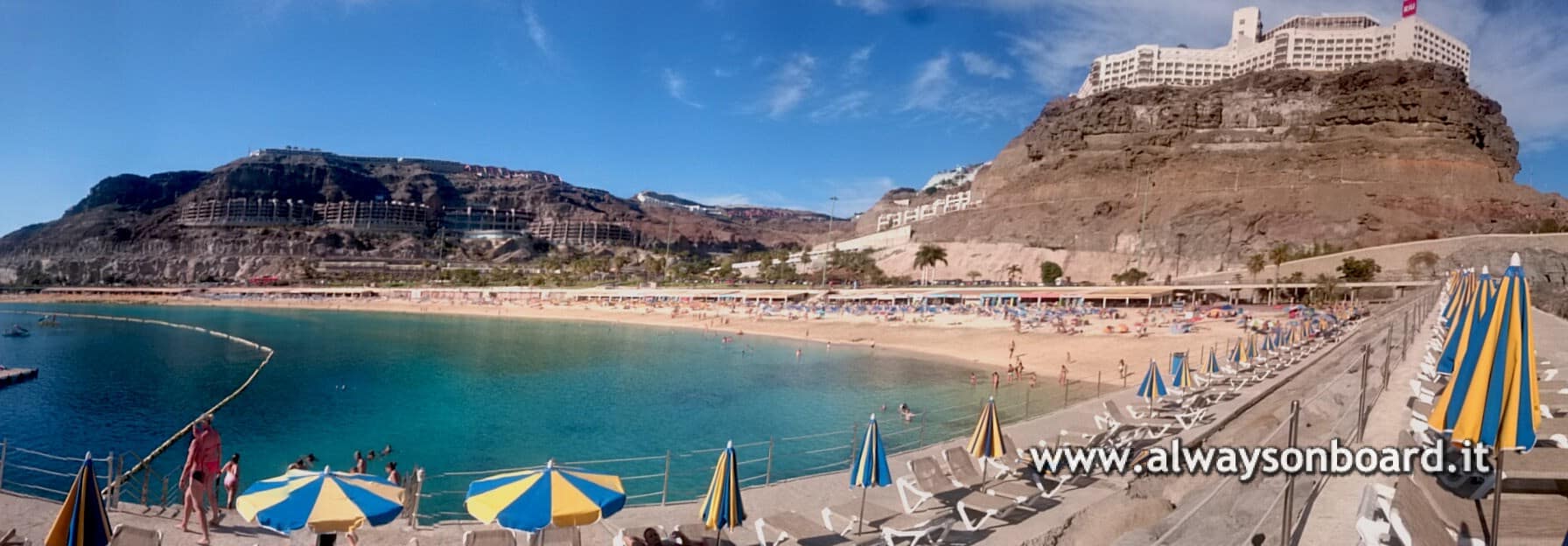
This is not to denigrate the beach, on the contrary I recommend everyone to visit it even if you’re staying elsewhere, because the waters are calm and also suitable for children; moreover, although the beach is very busy, it is really spacious and along the seafront there are restaurants, services, and every kind of commercial activity.
Just don’t be fooled by the over-edited photos on certain brochures. 😉
I recommend staying in the Puerto Rico area to those traveling in winter and to those who want to avoid too much chaos, traffic and nightlife, or to those who simply want to spend less than in Maspalomas.
I don’t recommend this area to those looking for lively nightlife or truly natural places (and in Gran Canaria unfortunately the major centers are all too heavily built-up in my opinion).
- XQ Vistamar: affordable seafront apartments with great reviews, accommodating up to 5 people;
- IG Nachosol Atlantic: 4 stars with great prices for child-free couples, free wifi, bar restaurant, parking, shared pool and hot tub.
- Holiday Club Jardin Amadores: 5 stars near Playa de Amadores with rooms and apartments for up to 6 people, sea view from its elevated position, wifi, free shuttle to the beach.
Playa de Mogan
Size: Medium
Pros: Another recommended area in winter as it is sheltered from the wind, close to a picturesque neighborhood with alleys and canals; well-served area with beachfront.
Cons: Among the most expensive areas on the island.
Playa de Mogan, sometimes also referred to as Puerto de Mogan from the name of the urbanizacion that includes it, is the second of the two most recommended areas in winter to stay in Gran Canaria.
What makes Puerto de Mogan special, a quieter village compared to the previous ones, is the presence of a beautiful neighborhood in front of the harbor full of flowers, alleys, and canals, also called (perhaps improperly) “la Venecia de Canarias.”
To be honest, more than a little Venice it resembles a neighborhood of certain Greek islands, that said it’s definitely a place worth visiting at least once. For example arriving in the afternoon, lying on the beach in front, and after admiring the sunset, having dinner at one of the many restaurants at the harbor.
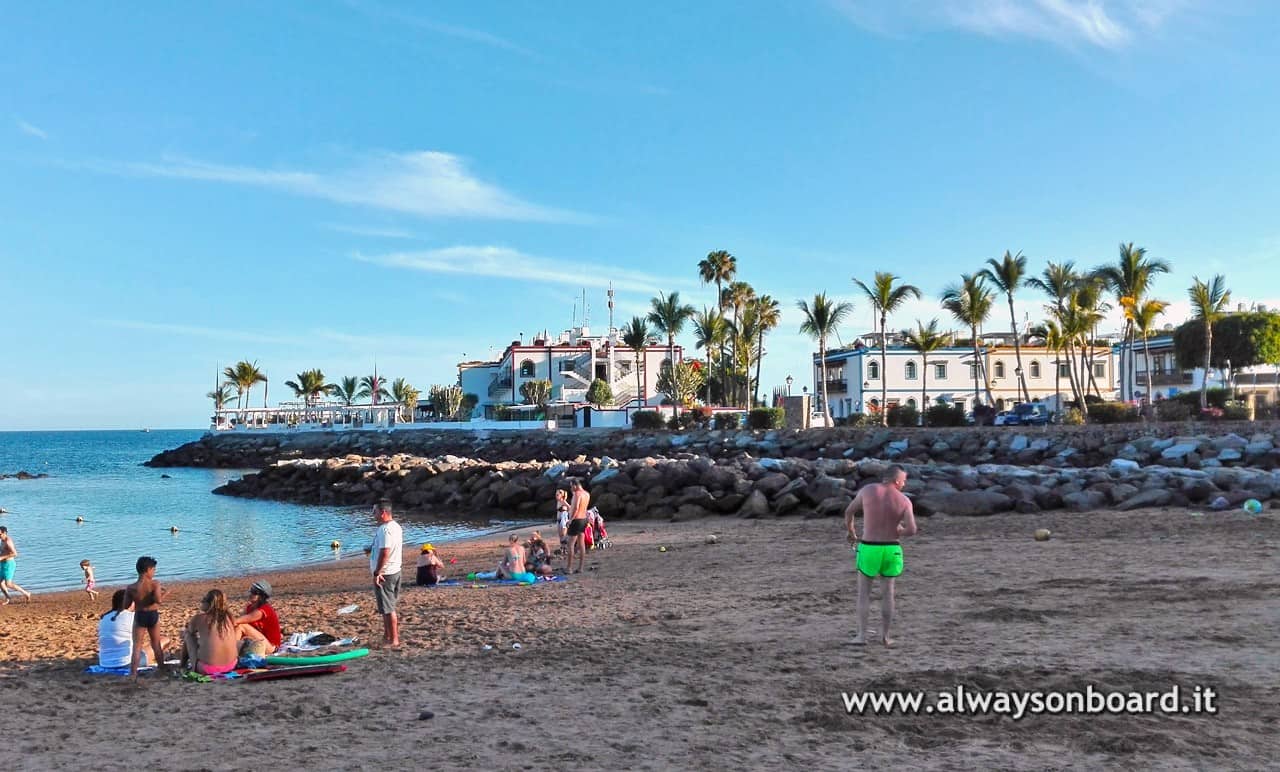
Staying in this area of Gran Canaria might cost you more than in other neighborhoods on the island; but if the “little Venice” has won you over, it might be worth it.
Let’s continue now with possible areas to stay in Gran Canaria in more traditional towns and villages less tourism-oriented.
Telde
Size: Medium
Pros: Traditional and non-touristy town, easier to find cheap accommodation, located roughly in the center of the island;
Cons: You need to travel to reach the sea.
Telde, (not to be confused with Teide, the great volcano on the nearby island of Tenerife) is a town on the eastern side of Gran Canaria that is a few kilometers from the beach, at times resembles a quiet secondary Italian town, with its squares, a few pedestrian streets, and overall not too much traffic.
I remember the small restaurants along one of the main pedestrian streets, where you can dine at lower prices than in tourist areas, also enjoying something more typical like queso de cabra or the inevitable papas arrugadas.
However, I don’t recommend Telde to those looking for nightlife: you would still have to travel to Las Palmas (closer) or Maspalomas, as evenings in Telde are quite calm, as this photo demonstrates:
Firgas
Size: Small
Pros: Truly traditional, well-kept, quiet village, more affordable.
Cons: A few kilometers from the coast and the tourist scene. You can visit everything in one hour.
Firgas is a small particularly peaceful village a few kilometers from the northern coast of Gran Canaria.
Even if you don’t choose Firgas for your stay in Gran Canaria, include it as a short stop of about an hour while passing through this area of the island, to visit a couple of true open-air tributes to the Canary Islands.
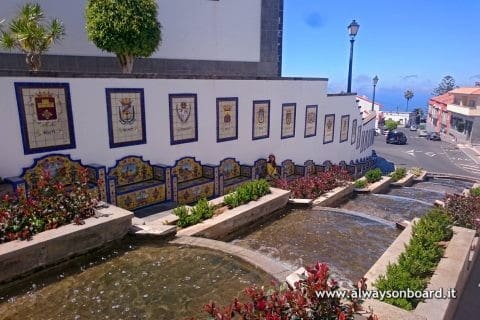
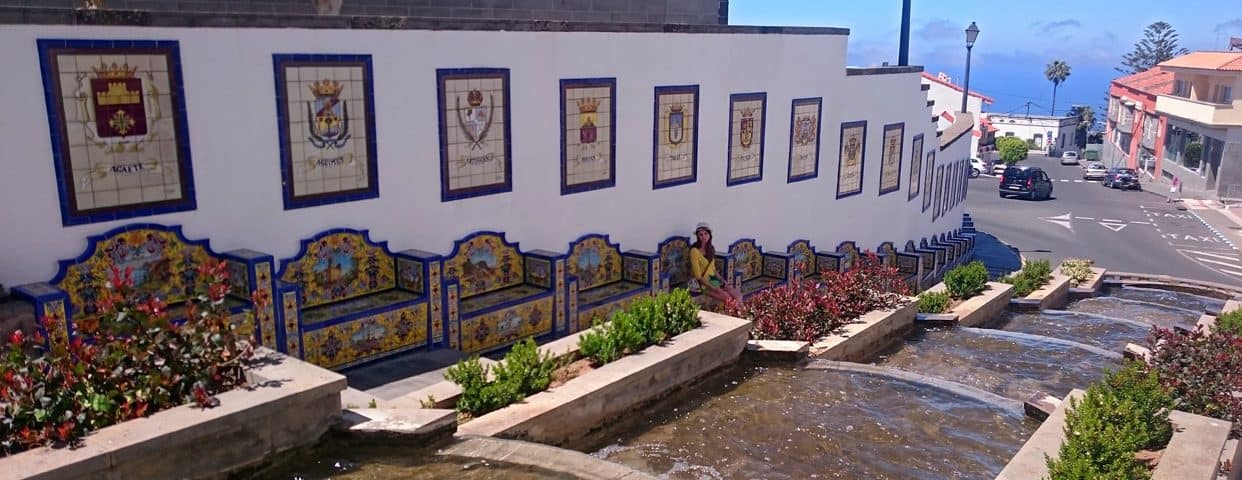
Among the unsuspecting streets of this quiet village there are in fact two adjacent, sloping avenues, very distinctive.
Along the first you can admire 7 sculptures where for each of the 7 major Canary Islands, you’ll find a raised outline, a painting of its landscape, and the coat of arms with some data.
Along the second avenue, in addition to a series of cascading fountains, there is a long row of “sofas” painted by the various ayuntamientos of the Canary Islands, in a style reminiscent of the famous Plaza de España in Seville.
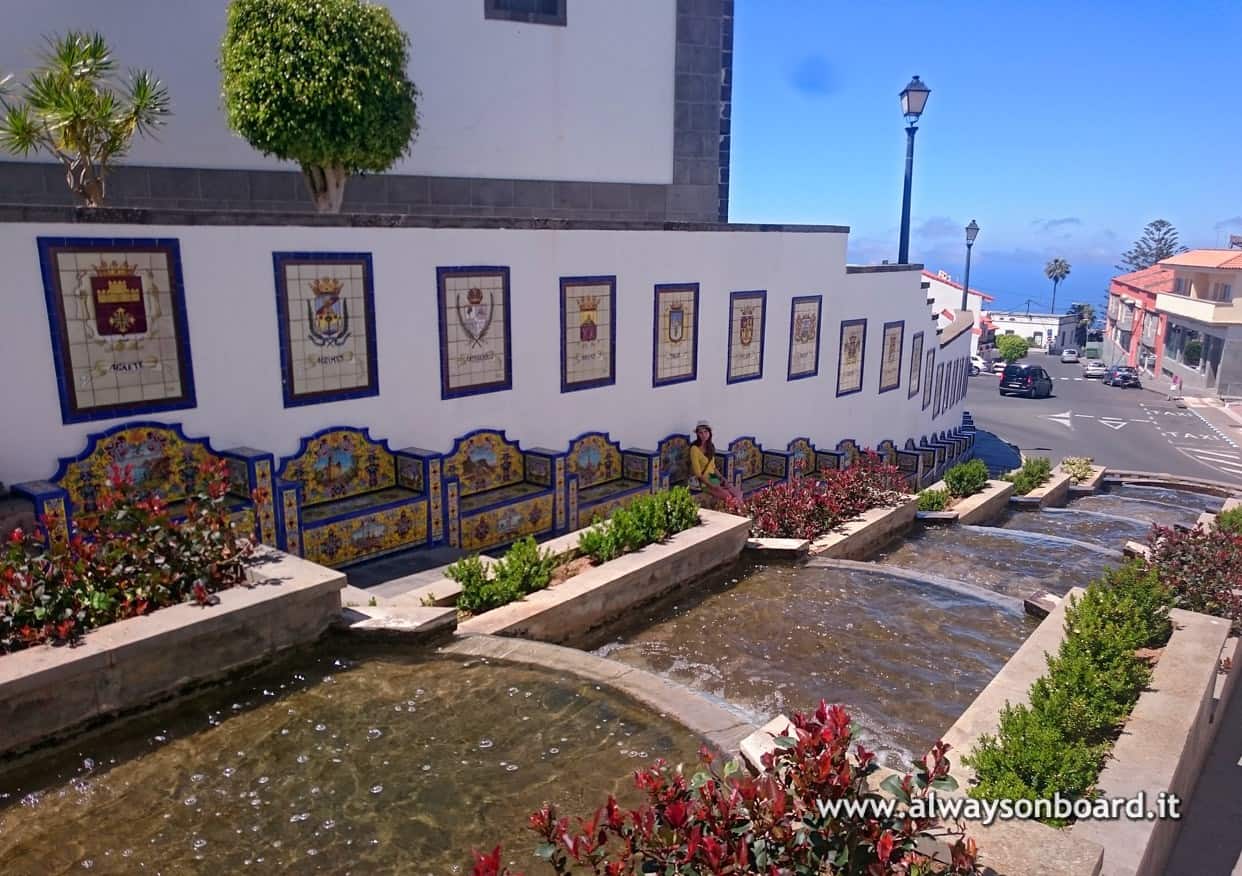
In Firgas you can really breathe peace and quiet, you’ll see small bars that look more like someone’s garage, and from the outer streets of the village you’ll have a view almost down to the sea.
Firgas is therefore an area to stay in Gran Canaria more suited for those seeking peace and savings, not needing a seafront room or planning to move around often.
It’s not recommended for those afraid of getting bored, those looking for nightlife, beach life, or traveling in winter; being on the north side it could be chilly.
Arucas
Size: Small
Pros: Traditional town with an ancient and majestic cathedral, well-kept and peaceful area.
Cons: For everything else you need to move around. The visit of the town is completed in a couple of hours.
Arucas is a small town with characteristics very similar to Firgas: similar geographic position, similar distance from the sea.
Also similar is the type of town center—well-kept, traditional, perhaps a bit more lively and visited thanks to the beautiful cathedral that rises up almost unexpectedly.
Besides the cathedral, there are also some lovely squares to rest in the shade of large trees and a freely accessible garden with plants and large bamboos.

Again, whatever your chosen destination for staying in Gran Canaria, a stop to visit Arucas is recommended. Two hours are enough, including a coffee break.
In the same style as Arucas, if you want to go deeper, you can also consider the village of Teror. It’s located even further inland, at a higher altitude (540m instead of about 200m) and it too has a beautiful well-kept center with more historic features.
El Puertillo
Size: Small
Pros: Small village near a rocky beach that turns into a natural pool depending on the tide; quiet and serviced area, more affordable.
Cons: No nightlife, not recommended in winter.
El Puertillo is a very simple village along the north coast of the island where to stay in Gran Canaria if you especially like the rocky beach in front that, depending on the tide, turns into a natural pool at certain times of day.
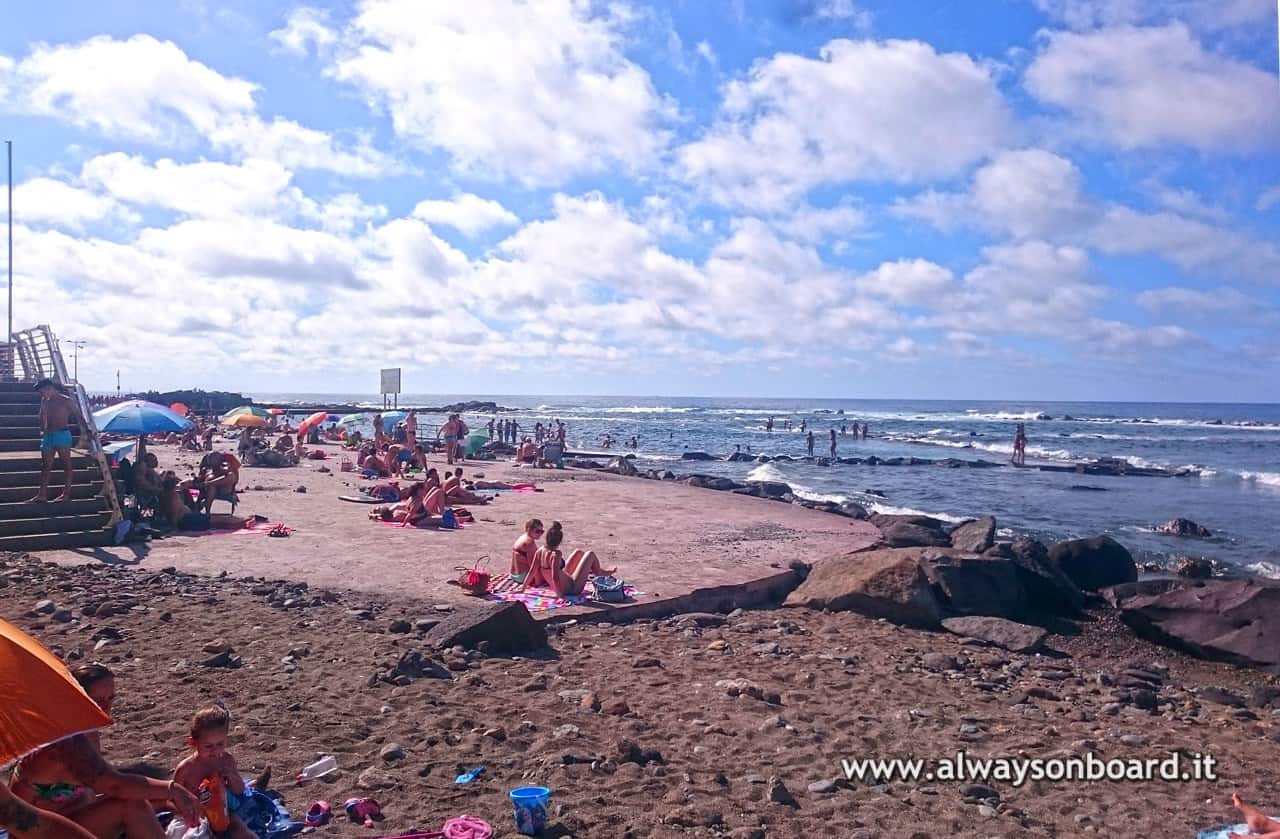
In El Puertillo you’ll still find the basic services, but obviously you’ll have to head south for all the other visits and attractions.
Where to stay in Gran Canaria in winter?
- Puerto Rico
- Puerto de Mogan
These are the most recommended areas to stay in Gran Canaria in winter since they are located in the south-west and are the most sheltered from the wind, allowing you a few hours of beach time in peace.
The east coast is usually quite windy (also in summer); the north coast is more prone to clouds, and the west is generally less accessible due to its geography.
If wind is really important (or worrying) to you, I always recommend downloading the Windfinder app on your smartphone, which shows wind forecasts with various details, including direction and intensity, to better plan your days and visits.
Where to stay in Gran Canaria for tradition and tranquility
In this case, the best choices for staying in Gran Canaria are the typical villages like Firgas, Arucas or Teror. If you like this style, you will also find other similar villages inland in Gran Canaria—just browse the map to find them! 🙂
For those afraid of getting bored, it’s better to head to the already mentioned historic district of the city of Las Palmas, so you have all other activities just steps away.
Where to stay in Gran Canaria with children or as a couple
If you’re traveling to Gran Canaria with children and don’t want to give up the sea, choose the southern areas of the island like Puerto Rico or Playa de Mogan which offer calmer, sandy beaches sheltered by the bay (like Playa de los Amadores or Anfi beach).
If you’re looking for a bit more life or luxury, the areas of Maspalomas and Meloneras can also be interesting.
Don’t forget you’are always in front of the ocean, which is not to be underestimated.
Where to stay in Gran Canaria for young people?
- Playa del Ingles in the Maspalomas area,
- the area of Meloneras, where there’s no shortage of taxis to quickly reach Playa del Ingles
- the city of Las Palmas, where nightlife is a bit more authentic and less touristy, but spread across several areas around the city and not concentrated in a single spot.
As already mentioned in the guide, keep in mind we are not talking about Ibiza, so during the low season months nightlife may be much quieter.
Finally… don’t forget to take a look at the island map and check if there are other places that spark your inspiration; especially if you’re looking for quiet villages or deserted beaches, Gran Canaria is full of them! 🙂
Now that you know everything about where it’s best to stay in Gran Canaria… it’s also time to discover what to visit, check out the most beautiful beaches and find a great flight! Do a search with the box below that compares all possible flights highlighting the cheapest and fastest ones: you might discover flights you didn’t know about.
Was this guide helpful? Share it with your friends or follow the official Facebook page to help the site grow! 🙂
Send a Tip 😍