
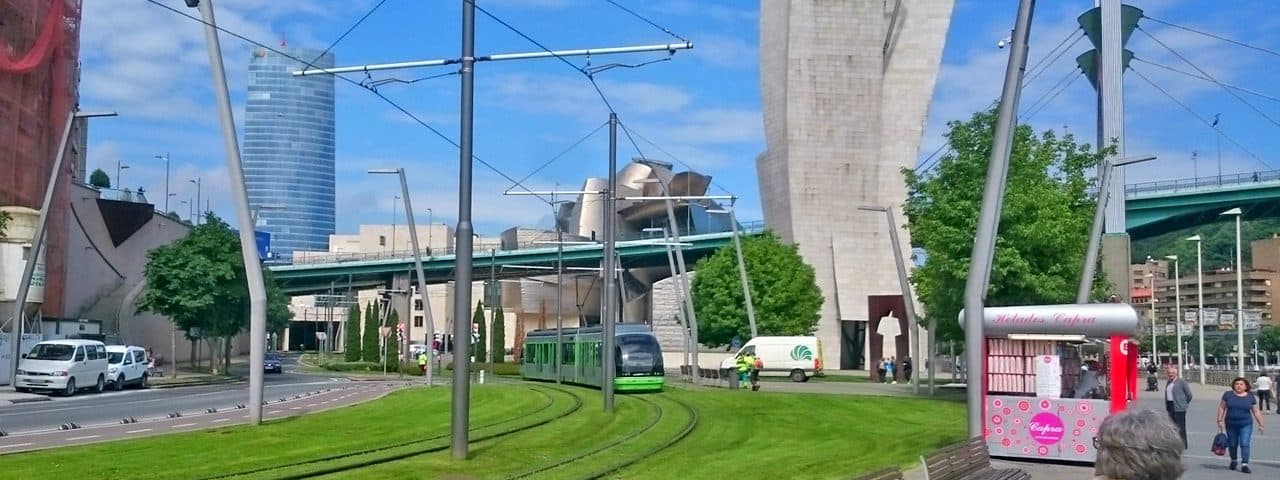
This guide will teach you all you need about public transport in Bilbao, summing up different means of transportation, tickets and prices, plus some tips.
Bilbao is well-equipped when it comes to public transport, and getting around is easy. In particular, metro is probably the most convenient and fastest way to visit this Basque city.
Then there’s a series of historic public transport options dating back a century, like the puente Colgante or the Artxanda funicular, which you should try at least once because of their uniqueness.
Public transport prices in Bilbao are pretty cheap. If you get the Barik Creditrans electronic card, you can use it for all of them and get much lower fares. But let’s take it one step at a time!
You may like: What to see in Bilbao in two days – recommended itinerary
Metro in Bilbao
Bilbao has three metro lines, with the two main ones essentially running along both banks of the “Deustuko Kanala” river, reaching as far as the northernmost part near the ocean.
When to take the metro in Bilbao
Bilbao’s metro lines can be useful:
- if you want to visit the northern areas near the ocean, where you’ll find attractions like the puente Colgante, the Getxo district, the Portugalete district, or, why not, a couple of beaches if you’re lucky enough to get a hot and sunny day.
- if you want to get from one side of Bilbao’s center to the other (or from Casco Viejo) if you’re tired of walking or short on time.
Read also: Where to Stay in Bilbao – recommended areas
How does the metro in Bilbao work? Fares and zones
Distances (and therefore ticket fares) are calculated on three zones, which you can see on the map below; ticket prices are calculated based on how many zones you cross. Below in the article you can find a detailed price table and links to official webiste with updated info.
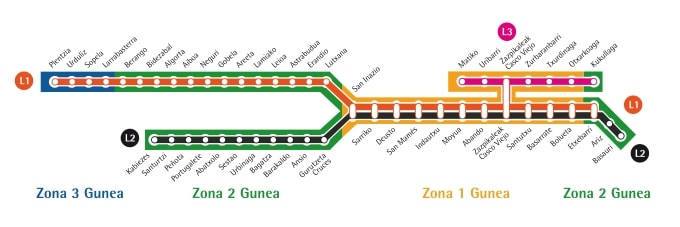
Bilbao metro map
Now that you know how it works, let’s also see where you can get to with the metro in Bilbao. The map below shows you the location of the various stops.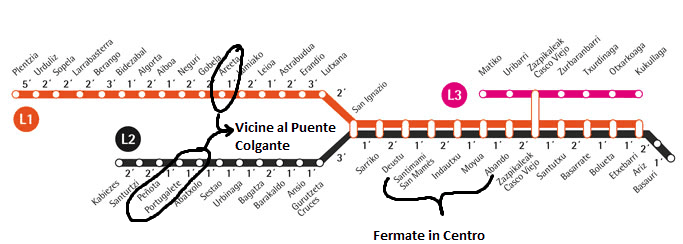
Some interesting stops are, for example:
- Peñota or Portugalete: in the Portugalete district of the same name, these are the closest stops to Puente Colgante on the south bank.
- Bidezabal: the metro stop in the Getxo district area and the closest one to reach a beautiful beach and a headland overlooking the ocean with a lovely walk and gardens.
- Areeta: the metro stop closest to Puente Colgante on the north bank of the river, which is definitely worth a visit and a stroll along the beautiful “riverside promenade” to the end at the river mouth.
- From San Mamès to Casco Viejo: these are 4 stops in Bilbao’s Modern Center and one in the historic center, known as Casco Viejo. These are the most convenient areas to stay; read my guide here on where to stay in Bilbao!
You can always find these maps updated on the official website.
Here, you’ll also find another map with a clear position of the stops in the area.
Besides these maps, I recommend downloading the offline navigator Maps.me onto your smartphone. This way, you’ll have the location of all the stops, lines, and points of interest in the city on a single map, so you can get around quickly even without too much advance planning. 🙂
Public transport in Bilbao: The Tram
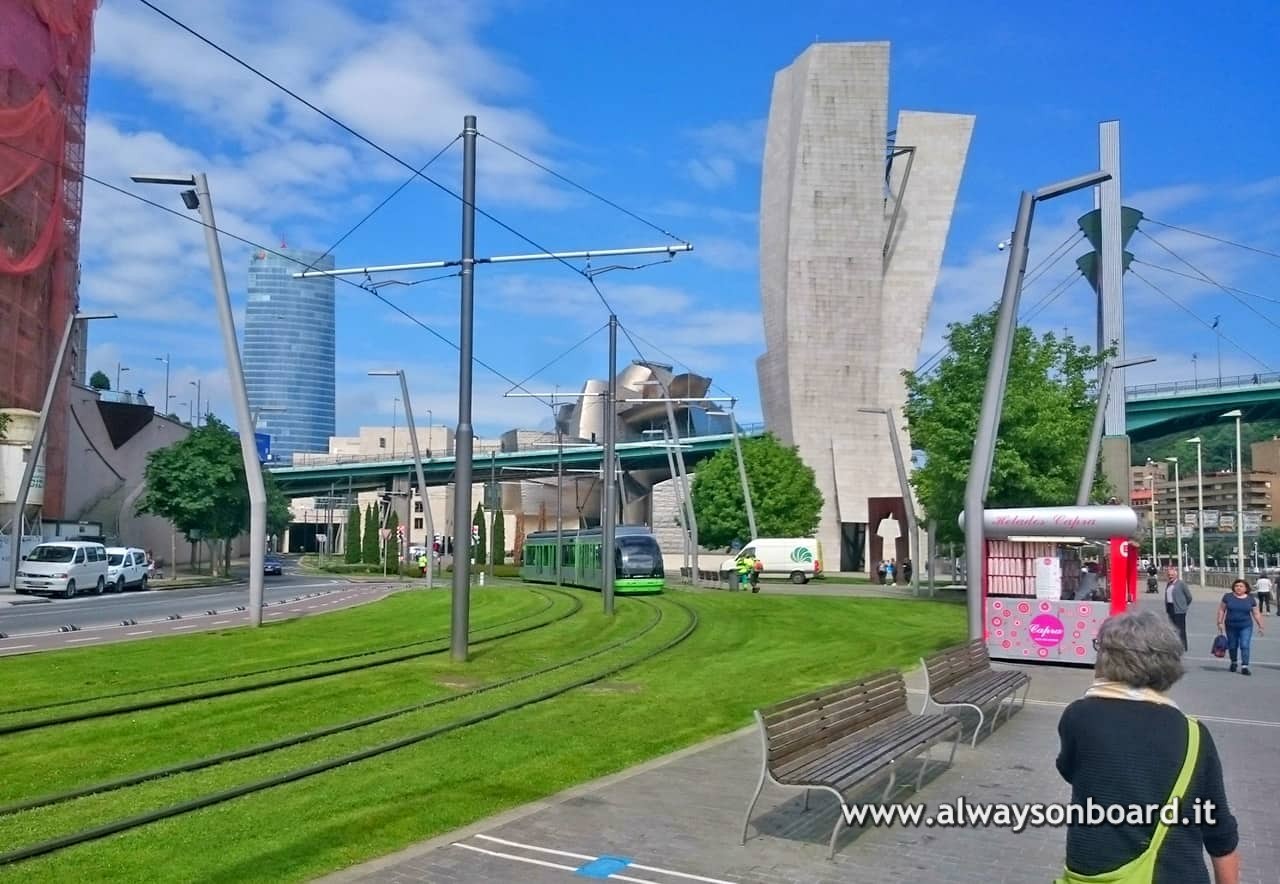
Bilbao also has a Tram line that almost completely loops around the city center.
It might be convenient for you to take the tram to reach, for example, the Guggenheim center if your hotel (or wherever you are during the day) is also near the tram line. In other cases, I don’t think it’ll be particularly useful, as most points of interest can be reached by other public transport in Bilbao.
The tram ticket price is €2.00 or €0.74 if you have the Barik card.
Public transport in Bilbao: The bus
In Bilbao, there are two bus companies, Bilbobus and BizkaiBus. The first handles urban routes, while the second goes further, like to the airport, for example.
In my opinion, the only time you’ll likely need the bus is from Bilbao airport to the center and vice versa, as for all other journeys, the metro and tram services are frequent and sufficient to reach all other points of interest.
From Bilbao airport to the center and vice versa
Once you’ve landed at Bilbao airport (BIO), as you exit the arrivals hall, you’ll find a stop for the A3247 bus (don’t be intimidated by the number, it’s the only one), which takes you to the city center.
The A3247 bus ticket has a fixed price of €4.50, and you can buy it directly from the driver or at the ticket office in the arrivals hall right opposite the stop. If you have a Barik card, however, you can use that, and the normal Zone 2 bus fare of €1.19 will be applied, which is much cheaper.
In the city center area, the A3247 bus makes several stops, most of them along Gran Via (the main avenue in the new center), before terminating at Termibus, which is a small bus station in the westernmost part of the center, San Mamès, near the stadium.
Depending on the season, the buses run from 5/6 AM until 11 PM/midnight. Here you’ll find updated info and fares, and here are the timetables for the lines, including the A3247.
Barik Creditrans Card and public transport prices in Bilbao
Like many other cities worldwide, Bilbao also allows you to buy a rechargeable electronic card valid for all public transport in Bilbao, including, for example, the metro, bus, tram, Puente Colgante, and the Artxanda funicular. You just need to top it up and hold it near the readers at the entrance of any public transport you want to take.
Having this card means you won’t waste time buying tickets every time and, above all, it allows you to pay a much lower fare compared to single tickets.
This rechargeable card can be bought at metro stations from the designated machines. You’ll find machines for single tickets and other specific machines for buying or topping up Barik cards.
The card doesn’t expire and isn’t personalized, so you can keep using it on future trips to Bilbao or give it to a friend.
Discounted fares with the Barik Creditrans Card
At this link, you can see the discounted fares applied to various transport options when using the card, but to give you some examples of the savings compared to standard tickets, I’ll summarize the differences for the main public transport options here:
| Single ticket | With Barik Card | |
| Metro zone 1 | €2.00 | €1.02 |
| Metro zone 2 | €2.20 | €1.19 |
| Metro zone 3 | €2.25 | €1.30 |
| Tram | €2.00 | €0.74 |
| Puente Colgante | from €0.60 to €1.70 depending on the time | €0.60 |
| Artxanda Funicular | €3 or €5 round trip | €0.70 per trip |
| Airport bus | €4.50 | €1.19 (Zone 2 bus) |
Before you rush to the machine to buy the Barik card, though, do the math, as the card has a fixed cost of €3 and must be topped up at least with 5€ upon purchase.
So, if you plan on making many journeys or taking the funicular, it’s definitely worth it, but if, for example, you’ll only make 4 metro trips, then single tickets would still cost you less than investing €8 in the card.
Private Transfers or Shuttles in Bilbao and to the airport
If, on the other hand, you don’t feel like getting around by public transport, paying attention to tickets, or you just want to reach your accommodation and then get around on foot, you might consider a private transfer.
One example of a service now widespread throughout Europe is Welcomepickups: on their website, you can immediately see the final price by entering the precise address of your destination.
If you want to travel a little with public transport in Bilbao and mainly get around on foot, the best solution is to find strategically located accommodation: here I explain where it’s best to stay in Bilbao!
Did you like this article? Follow the official Facebook page or the Instagram page; it costs nothing, helps the site grow, and keeps you updated on new articles! 🙂



Hi – this information has been really helpful to me – older single traveller who is having a crash course in using platforms like yours to navigate my way around Bilbao! Especially helpful as I’m only in the city for two days.
Just one question – can you buy the Creditrans card at the airport?
Thank you Stella, as far as I know there’s no card available at the airport. But things may change in the future, so in case let us know!