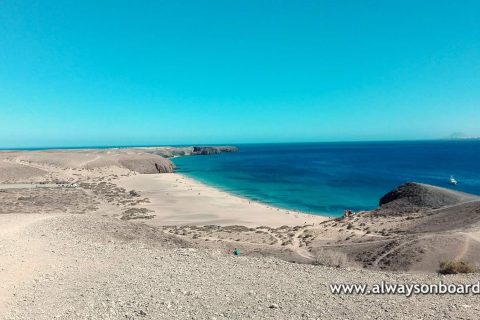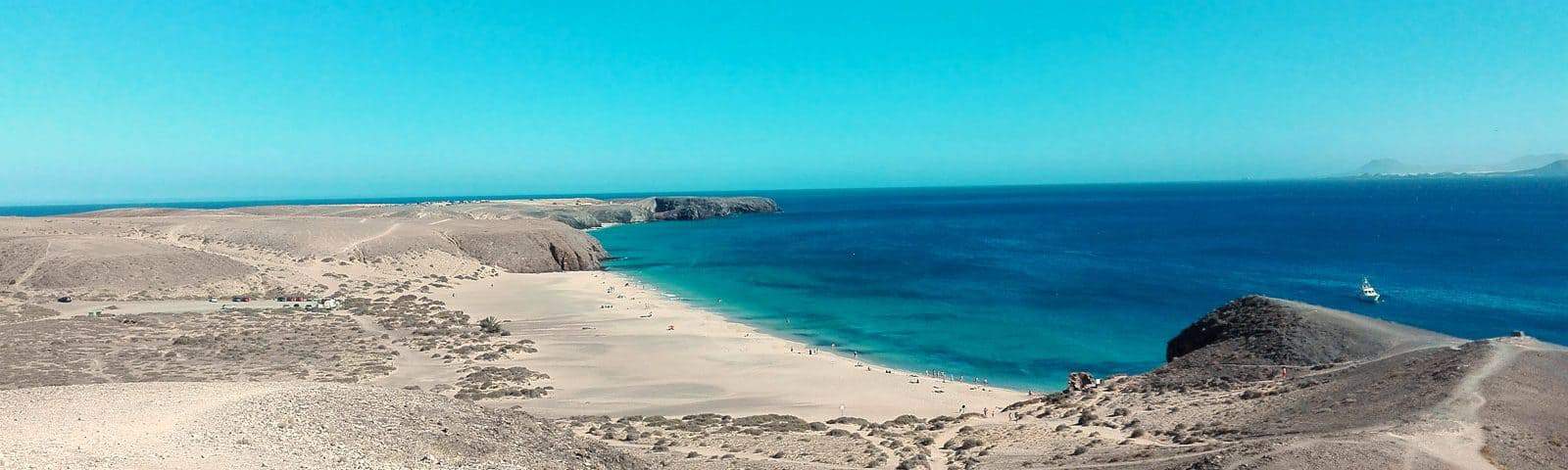
Lanzarote is a beautiful island in the Canary Islands archipelago, which, although more famous for the spectacle of its volcanic landscapes (like the incredible vineyards between the craters), is also a great choice for those who love beautiful beaches. In this guide, we will discover the best beaches in Lanzarote that you cannot miss during your trip.
Although it is a relatively small island, there are countless coasts and beaches in Lanzarote that deserve a visit, so don’t be offended if you know one that isn’t listed (in fact, please let us know in the comments! 🙂 ). Here we will look at the most interesting ones, suited to satisfy everyone’s tastes: and I’m not joking. In fact, in Lanzarote, you’ll find beaches of all types: sandy, pebbly, rocky, light or dark volcanic sand, with full services or scattered in the most untouched nature!
Map of the Best Beaches in Lanzarote
Let’s start, as in all guides, with a practical map of the best beaches in Lanzarote, and then we will go into detail and examine them one by one.
On the map, you’ll find the beaches of Lanzarote that we will analyze: each color suggests a potential set of beaches to visit on a single day of your trip, in case you only have 4 days to spare; finally, some useful parking spots are also indicated to help you reach them, which I will talk about in the guide.
Parque Natural del Papagayo
Let’s start the tour of Lanzarote’s most beautiful beaches from the southernmost part of the island, in a protected area called “Parque Natural del Papagayo,” which includes the namesake Playa del Papagayo, Playa Mujeres, Playa del Pozo, and Playa Caleta del Congrio, as well as other smaller coves. These are indicated by the orange pins on the map.
Playa Papagayo
Overall rating: 9/10
Services: a bar/restaurant
Accessibility: Quite Easy
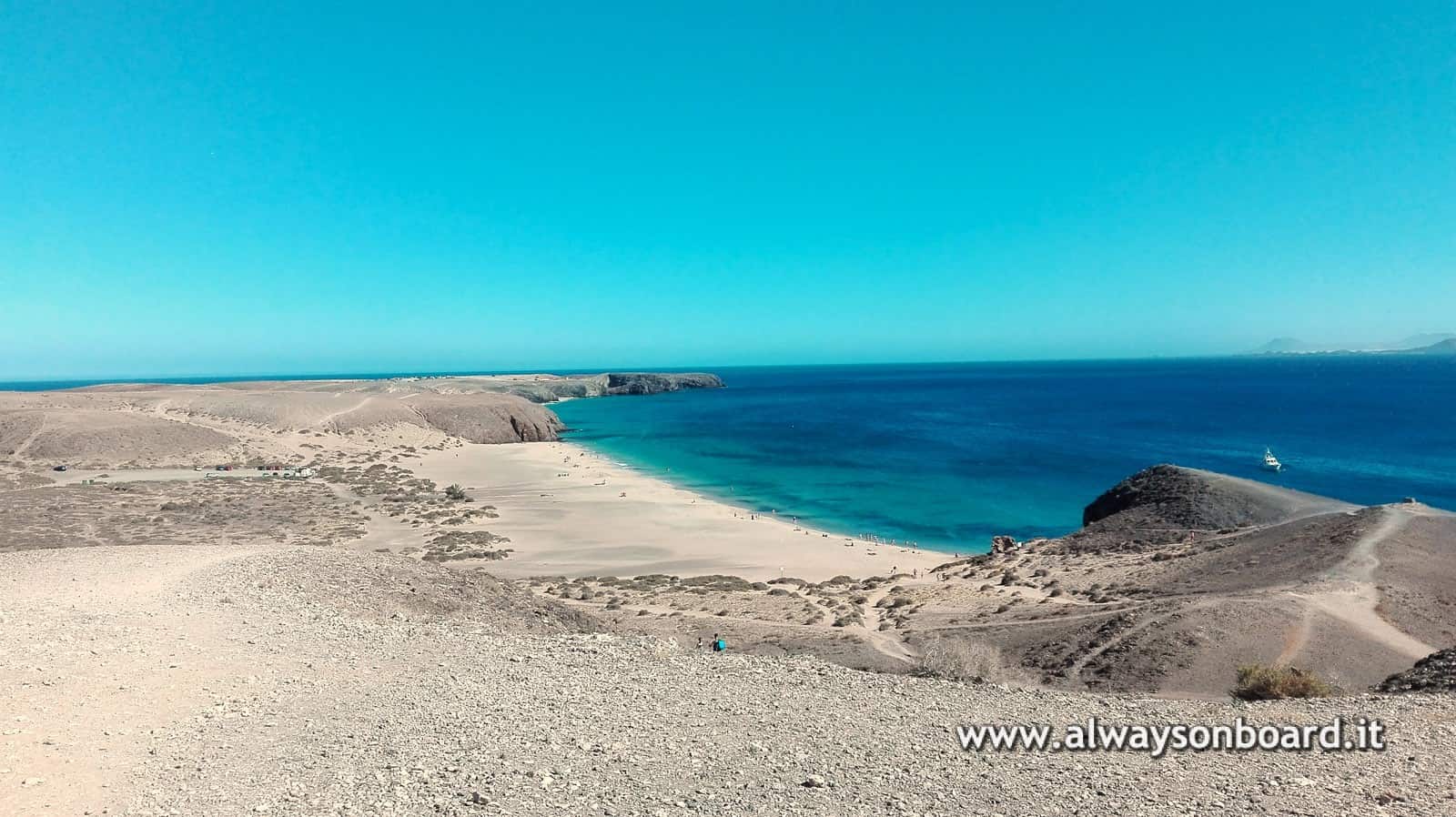
Let’s start this review with the most famous beach in Lanzarote: Playa Papagayo.
This beach, which bears the same name as the natural park it is located in, is the most popular on the island and you will easily find it in photos in articles or guides about Lanzarote.
It is a crescent-shaped beach, fairly sheltered at both ends, which is reached by descending a short staircase at the top of which, besides the parking lot, you will also find the only bar/restaurant in this area if you want to grab a bite.
Thanks to the lateral protections, the water and waves are less intense compared to other beaches. Still, don’t let your guard down, especially with children, as it is still the open ocean.
The beauty of Playa Papagayo is greatly enhanced by the presence of the sun. If it’s sunny and there are no clouds, the color of the water and the fine sand takes on incredible shades, framed by the variety of colors along the perimeter of the beach (rocky at the ends, sandier in the center).
In case of overcast weather, the view may seem a little duller, so if you have a choice, prefer a sunny day (or variable, so you get a bit of relief from the sun’s strength; remember that there are no umbrellas/sunbeds at the beaches of this natural park).
To visit Playa Papagayo, as well as other beaches of Lanzarote in this completely natural area, I recommend bringing plenty of water due to the scarcity of services, a snack if you don’t want to crowd around the only available venue, as well as sunscreen and sun protection.
How to Get to Playa Papagayo
A few useful tips on how to reach Playa Papagayo (and all other beaches in the natural park that we will see shortly, such as Playa Mujeres).
All the beaches of this southeastern corner of Lanzarote can be reached by car, via a gravel road that is quite challenging in places, up to a parking area just a few meters from each beach.
Access to this gravel road requires payment of a 3-euro daily fee; on this 4-5km stretch of road, you should be very careful with the numerous protruding rocks and potholes, especially since almost all car rental companies on the island do not cover damages to unpaved roads, even with additional insurance. So proceed at a walking pace, especially in the first section, which is the worst, because any damage could become a problem.
The patience in traveling it will be rewarded when you return, with a view like this:
The classic road to access the park is the one marked in yellow on the map below, starting from the main roundabout on the road coming from the north. If you want to avoid a section of this rough road, you can detour onto the blue, paved route and then re-enter the yellow route just before the toll booth for the payment, marked by the red pin.
If you don’t have a car, want to avoid this road, or find the tolls irritating (especially for roads in these conditions), there is a free alternative, as long as you don’t mind walking.
By parking at the point indicated by the P blue on the map at the end of the Castillo del Aguila neighborhood, you can walk along a wide path of about 600 meters that leads you to Playa Mujeres, the first major beach in the Playa Papagayo complex, allowing you to admire it from above, as shown in the picture just below.
From Playa Mujeres, if you’re an avid walker, you could also reach all the other beaches since they are all connected by wide trails. It’s about 1.5km to Playa Papagayo. So, depending on your preferences (and the scorching sun), you can decide whether it’s better to visit them on foot or by car.
- Sandos Papagayo Beach Resort: a 4-star resort with rooms for 1 to 4 people, a spa, gym, and pools,
- Villa Pura Vida: a beautiful 180 sqm holiday home that accommodates up to 6 people, with a terrace, mountain view, spacious rooms, 3 bedrooms, and 2 bathrooms, including a bidet.
Playa Mujeres
Overall rating: 7.5/10
Services: None
Accessibility: Quite Easy
Playa Mujeres is a particularly wide beach, although it may not seem so from the map. This beach is also without services, so don’t forget water, sunscreen, and possibly umbrellas.
At Playa Mujeres, as well as at Playa del Congrio, which are the two largest beaches in the area, nudism is practiced, usually on one side of the beach. Given the size and the relatively few visitors, it will certainly not be disturbing even for those who don’t enjoy that.
This beach faces directly onto the ocean without any special protections, and the seabed drops steeply; be careful of the waves and do not leave children unsupervised.
Despite the choppy waves, the color of the water is very pleasant, and for those who enjoy snorkeling or diving, it will not disappoint.
As mentioned earlier, Playa Mujeres can be easily reached on foot from the nearby neighborhood, so if you only have time to visit one beach or want to avoid the rough road to enter the park, it might be an added convenience.
If you feel like walking along some easy paths beyond the cliffs of Playa Papagayo (or simply moving a bit by car if you’ve entered via the main road), you can reach many other smaller beaches, like Playa Caletón San Marcial, Playa de la Cera, Playa Puerto Muelas, which you can spot simply by zooming in on the map above.
Playa Caleta del Congrio
Overall rating: 7.5/10
Services: No
Accessibility: Easy
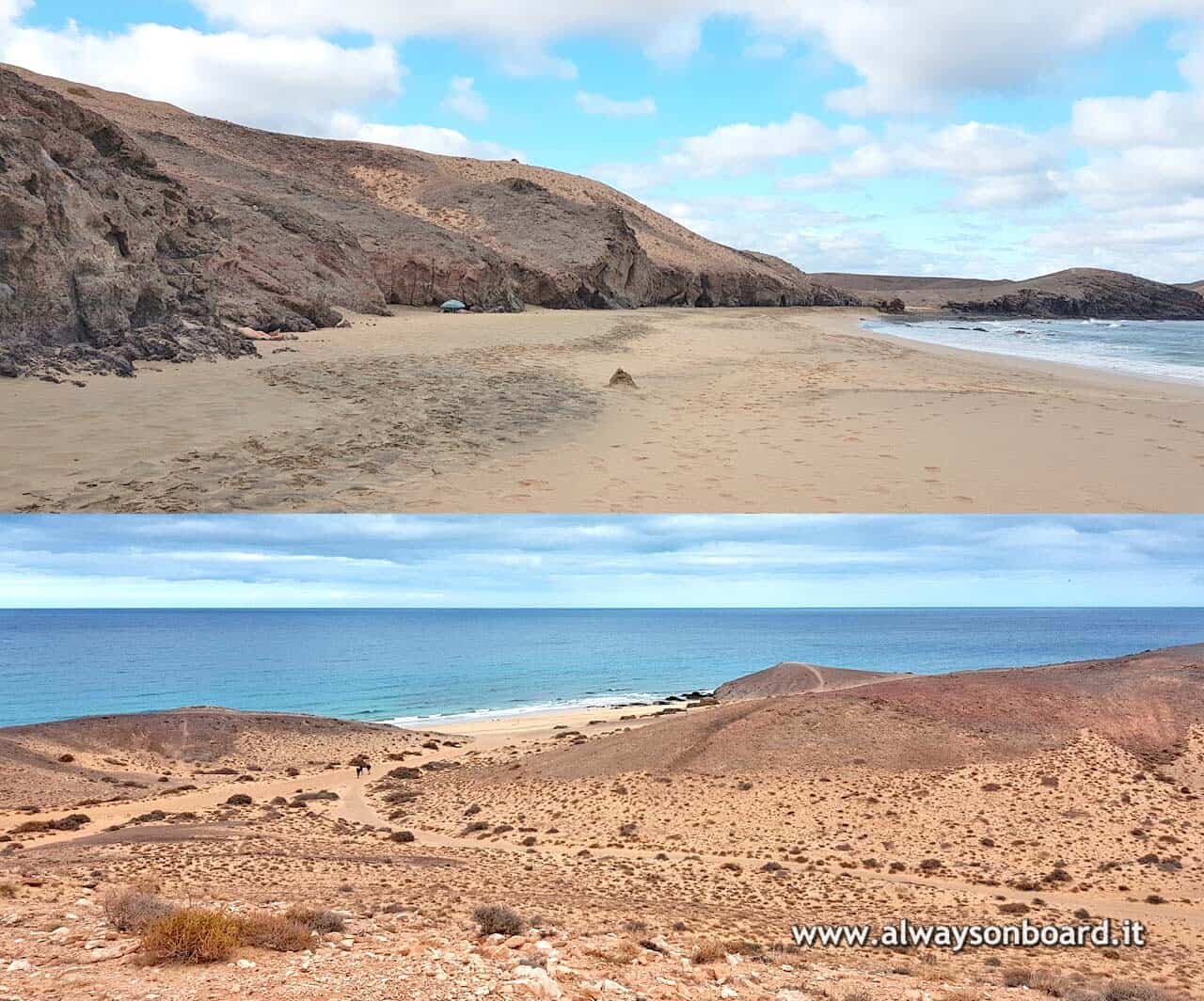 Caleta del Congrio beach above and a glimpse of the path to reach it below
Another one of the larger and more relaxed beaches of Lanzarote in this area is Playa Caleta del Congrio. In the photo, you can admire it in all its tranquility towards sunset, although even in broad daylight, the risk of crowds is rare.
To get to Playa Caleta del Congrio, after parking, you will need to follow a simple and wide path, part of which you can see in the photo. At all parking areas, you’ll find signs indicating the direction to the various beaches, so you can’t get lost.
As with the previous beaches, the same considerations apply regarding precautions and what to bring. This beach faces east instead of south, so don’t go too late in the afternoon because it will end up in the shadow.
Beaches of Lanzarote in the South with Services
Playa Dorada and Playa Flamingo
Overall rating: 7.5/10
Services: Yes
Accessibility: Easy
Playa Dorada and Playa Flamingo, two very similar beaches in the south of Lanzarote, are beaches near the center of Playa Blanca (which this time is the name of the town, not a beach: in Lanzarote, it’s easy to confuse the names of neighborhoods and beaches).
You’ll find them marked on the map above with green pins.
These two beaches of Lanzarote have the typical cove shape with rocks positioned artificially on the sides to somewhat reduce the force of the waves.
Playa Dorada and Playa Flamingo are the most suitable beaches for those with children because they offer the most common services and the water is among the calmest on the island, with a gradually sloping seabed.
Even on these beaches, the water colors and the visual effect change quite a bit depending on the sunlight and time of day, as you can see in the following photo with full sun and the previous one just before sunset.
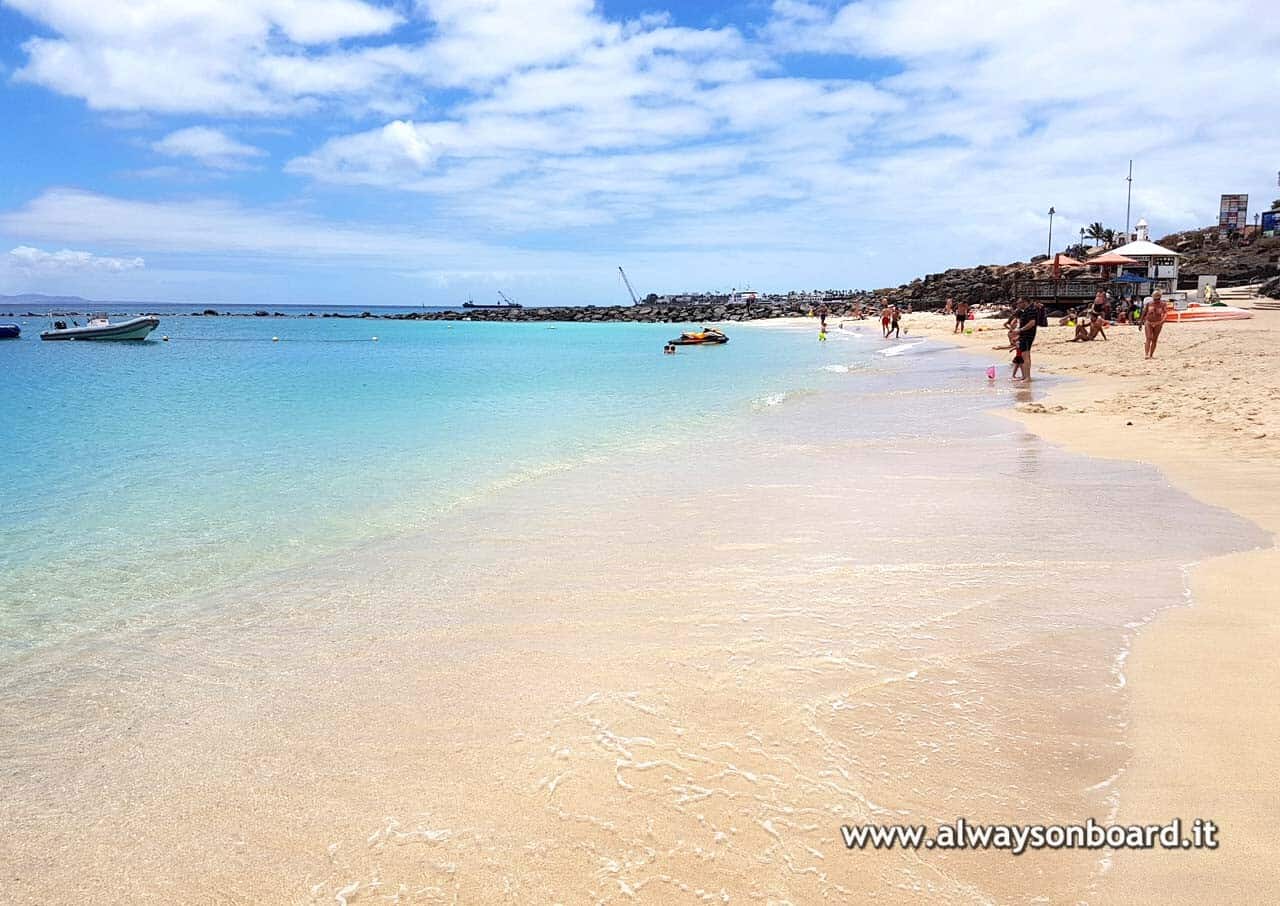 Playa Dorada at its best in colors
All around Playa Dorada and Playa Flamingo, you can also find restaurants and commercial activities, allowing you to consider a dinner at sunset, which, with the sun setting over the sea, could give you some nice emotions. If you’re here at sunset for several days or, simply, don’t feel like dining here but want to try something much more typical, I recommend a visit to the village of El Golfo, which I’ll talk about soon in another article.
- Iberostar Lanzarote Park: 5-star resort on a “rocky point” that offers a nearly 180-degree ocean view. Just a few steps from Playa Flamingo, it offers free gym access, parking, WiFi, sauna, hammam, solarium, and 4 pools.
- THB Royal: 3-star hotel at good price with 2 pools, 24-hour reception, air conditioning, near Playa Dorada and the Papagayo shopping center, easily reachable on foot for a comfortable evening out. Rooms for up to 3 people.
- Casa Fantasia: 80 sq.m. apartment with terrace, kitchen, refrigerator, accommodates up to 4 people at a very competitive price. WiFi, parking, pets allowed.
Otherwise, have a look at my guide about where to stay in Lanzarote to check out all best areas and find one that fits your needs.
How to Get to Playa Dorada
To get to Playa Dorada, you can park at the entrance of the “Centro Comercial Papagayo,” following the blue pin on the map.
At the Centro Comercial Papagayo, there are also a couple of bars/pubs open in the evening if you want to stay until late: this is the most active area of Playa Blanca during the evening.
However, don’t expect a big nightlife scene here at Playa Blanca. If you’re looking for nightlife, the best area to move to is Puerto del Carmen.
Read also: Where to stay in Lanzarote and where not to!
How to Get to Playa Flamingo
Getting to Playa Flamingo is easier; just head to the area near the entrance along Avenida de Las Canarias, where you’ll also find plenty of parking.
Beaches of Lanzarote in the Central Area of the Island
Playa de la Arena
Overall rating: 7/10
Services: No
Accessibility: Medium
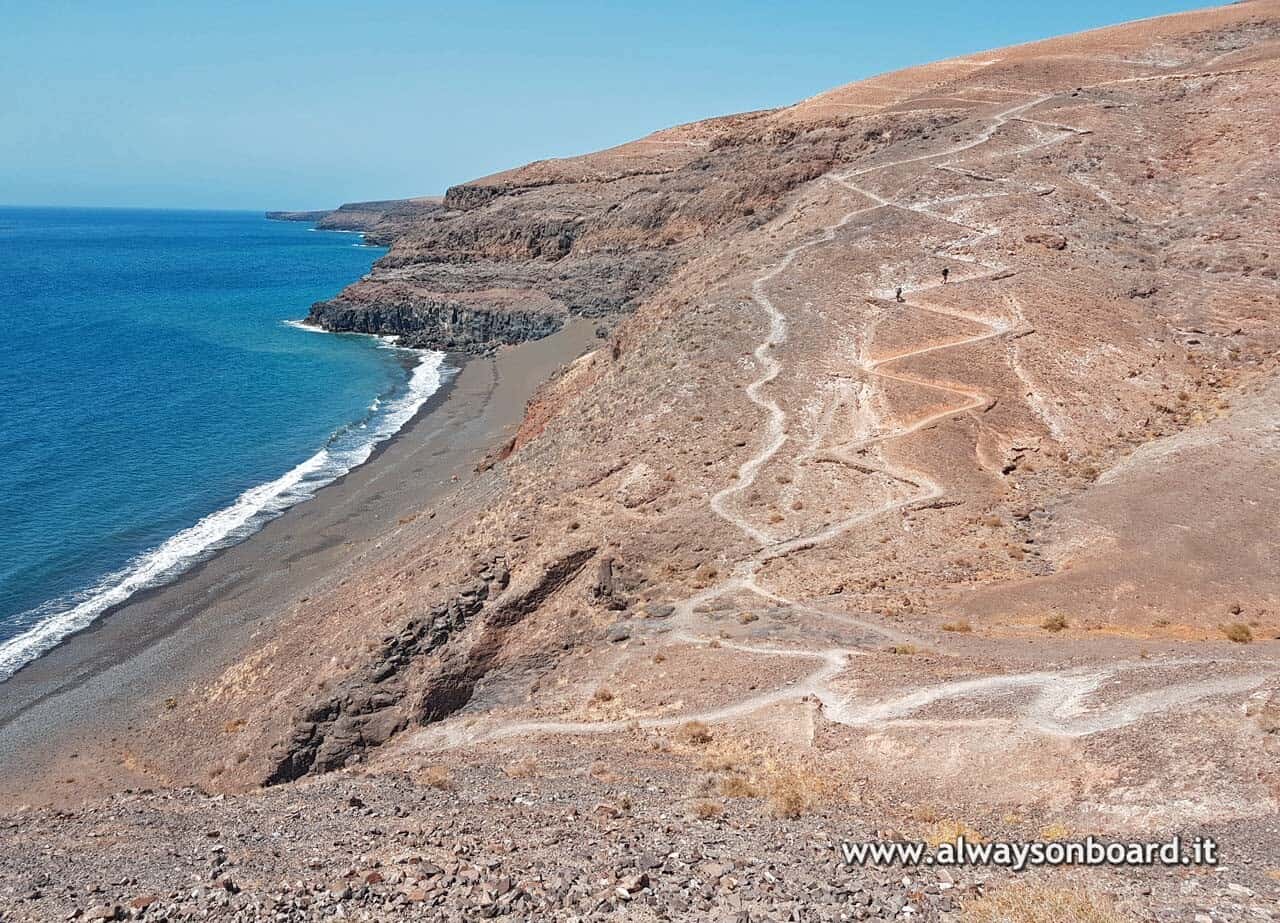
Playa de la Arena is another natural beach in Lanzarote with no services located just a short distance from the village called Playa Quemada (remember how easy it is to confuse names I mentioned earlier?)
This beach, marked with a yellow pin on the map, is partly dark sand (but not completely black) and partly pebbles and rocks.
It’s usually less crowded and a bit more challenging to reach, will also give you a sense of privacy, and if you’re lucky, you might even be alone.
To get here you need to park your car at the village of Playa Quemada, being careful not to park in no-parking zones or disturb the few inhabitants of the village, then walk west along a path that will take you with a bit of elevation down to the beach.
On this beach in Lanzarote, the water is quite rough, and the seabed is unpredictable. If you want to try swimming, pay the utmost attention. Or, alternatively, take a walk to the far end of the beach, where you’ll find a curious mound of sand with a slope of almost 45°, completely smoothed out by the wind. 🙂
Don’t go to Playa de la Arena too late in the afternoon, as facing southeast, it may end up in the shadow and lose its charm (and also lose temperature if it’s windy 😆 ).
Playa Grande
Overall rating: 6/10
Services: Yes
Accessibility: Easy
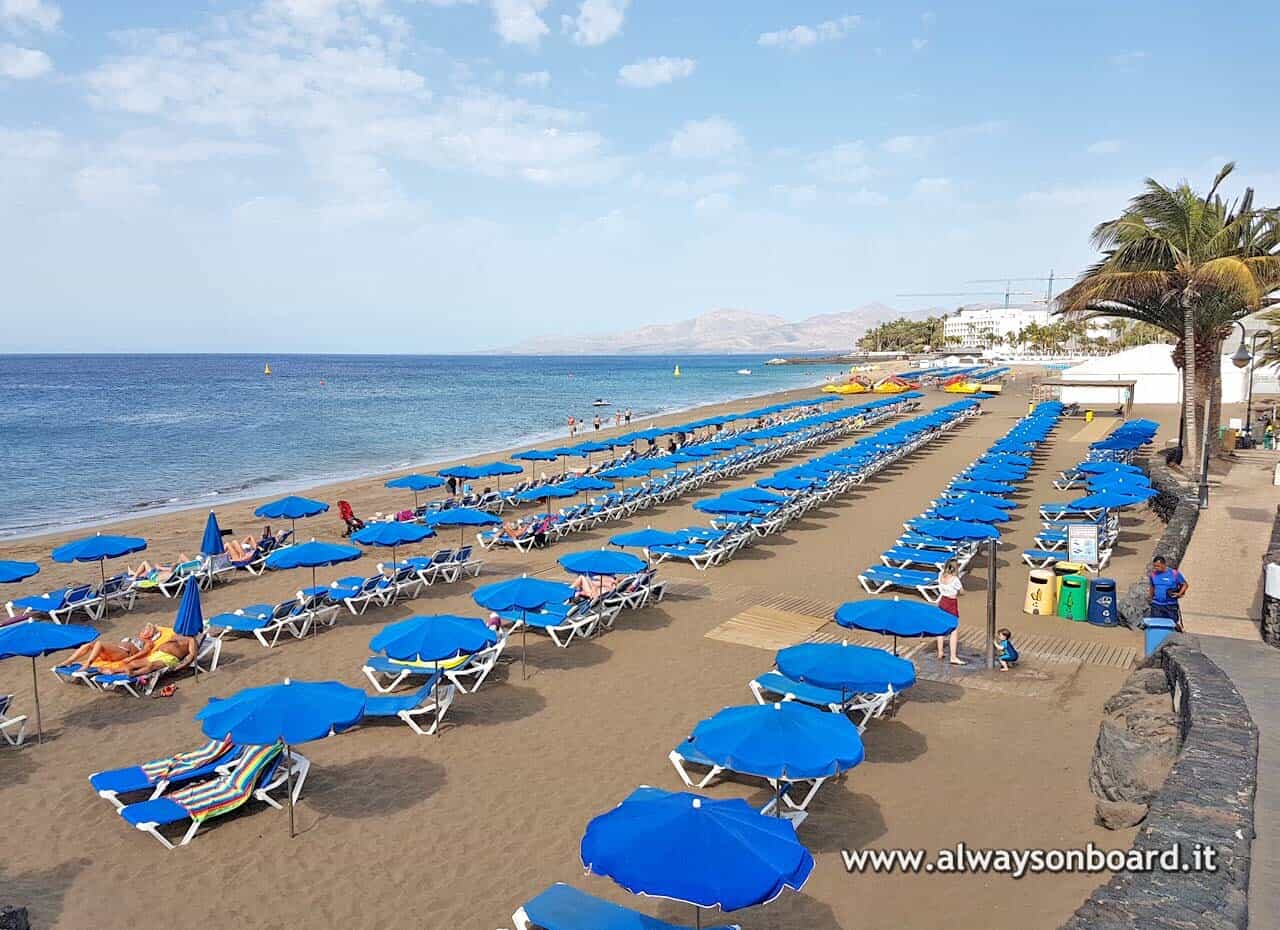 A glimpse of the beaches along the coast of Puerto del Carmen
Now let’s talk about Playa Grande: this is the beach (or rather, one of the beaches) directly in front of the town of Puerto del Carmen, one of the most popular and frequented urbanized neighborhoods on the island, as well as one with a lively nightlife.
It is a typical “town” beach: sandy, well-maintained, and with all the possible services available. Certainly not the most charming beach in Lanzarote, but it does have a well-kept and well-built promenade just behind it, with volcanic rocks from the island that don’t make the artificial aspect stand out at all.
Playa Grande is a good beach for a short break if you’re staying right in Puerto del Carmen and don’t have time or inclination to move elsewhere.
Read also: All good areas to stay in Lanzarote
By walking along the shore, you can reach other beach areas, all of which are of similar quality. The waves are usually calmer compared to other beaches on the island.
Along the coast that stretches from Puerto del Carmen to Arrecife, you’ll also find several other beaches (such as Playa de Los Pocillos, Playa Matagorda, Playa Honda, and others), which are similar to Playa Grande, both in terms of size/sand and services and urbanization behind them. These beaches, which you can definitely visit if you have plenty of time, will not be explored in detail here, as in my opinion, they don’t represent the true soul of Lanzarote, and being very close (if not adjacent) to the airport runway, I don’t consider them unmissable.
Playa Janubio
Overall rating: 7.5/10
Services: No
Accessibility: Easy
To conclude the list of Lanzarote beaches in the central area of the island, let’s look at Playa Janubio, a beach perhaps more for “seeing” at sunset for its uniqueness than for tanning, and probably more convenient to visit when you’re in the south of the island, which can be reached in a few minutes. That’s why it’s marked with a green pin on the map.
Playa Janubio is a completely black volcanic beach and varies along its entire length between very fine sand, small polished pebbles, and large stones. All accompanied by a foamy effect from the waves on the sand that will entertain you for a while.
Behind it, there is also a small pond/lagoon, nothing particularly exciting really, the beach is much better.
I recommend visiting Playa Janubio in the late afternoon so you can then continue your visit to “Los Hervideros” and end up at the village of El Golfo for a truly typical dinner in one of the peaceful and relatively inexpensive restaurants in the village. But I’ll talk about this in another article.
Beaches of Lanzarote in the North of the Island
Finally, let’s take a look at the beaches of Lanzarote in the northern area of the island, marked with red pins on the map.
The beaches in the northern area of Lanzarote are, in my opinion, the most beautiful and picturesque, if you’re lucky enough to find them on a sunny day with not too much wind. Let’s see why right now! 🙂
Natural Pools of Punta Mujeres
Overall rating: 7/10
Services: No
Accessibility: Easy
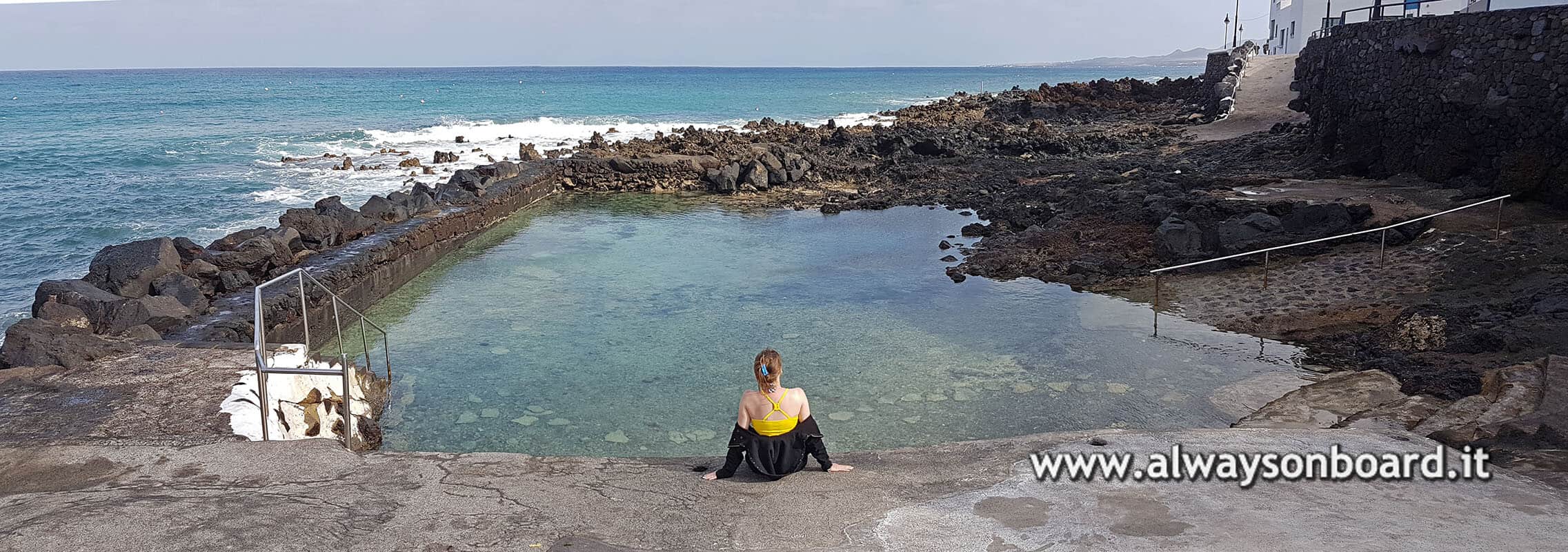
Punta Mujeres is a small village about 500 meters in diameter with a particular appearance, and depending on how rough the sea is, it can also feel a bit wild.
In this area, characterized by a rocky and somewhat rough coastline, some natural pools (although one has been completed artificially) have developed. To find them, you just need to walk along the short stretch of seafront. 🙂
Here, you’ll easily find locals coming to swim. However, the area is probably not suitable for families with small children.
Piscina Natural Coloseo
Overall rating: 9/10
Services: No
Accessibility: Easy
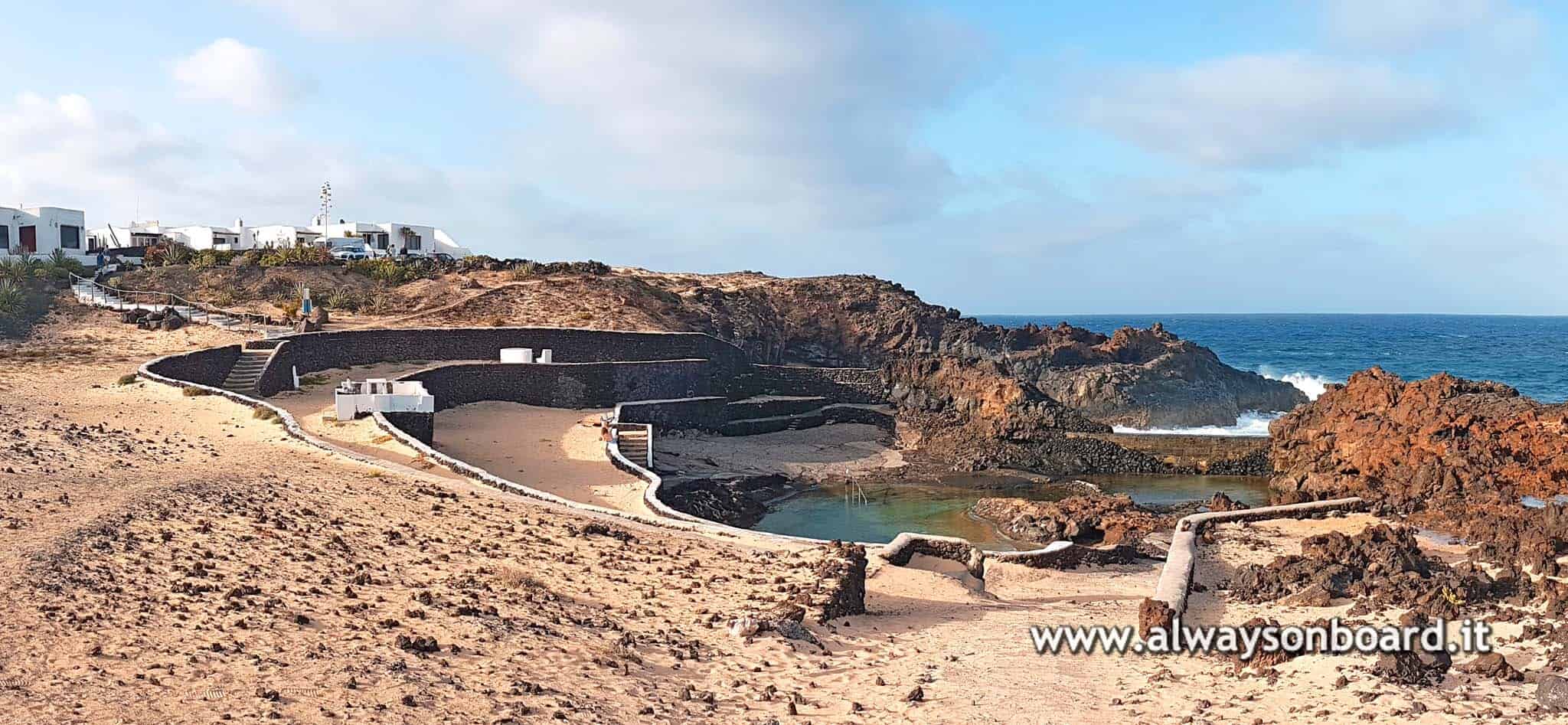
This beach in Lanzarote, just by its name, should suggest something to you 🙂 Well, it’s a natural pool (or almost), surrounded by a sort of multi-level beach, as if it were a theater.
The Piscina Natural Coloseo is a spectacle even just before sunset, when, with no one around, you can watch occasional waves full of energy behind the rocks that, with the highest splashes, pass over and always bring some new water into the pool.
Inside the natural pool, there is also a handrail to help you enter, with a sign inviting you to hold on; don’t act cocky, or a slip is guaranteed 🙂

If you walk along the cliffs southward from the Piscina Natural Coloseo, in addition to numerous spots for taking photos on one side and several high-end beach houses on the other, after a while, you will also find a second, smaller pool with the same style, in case the first one is too crowded. 🙂
Caleta del Mojon Blanco
Overall rating: 7/10
Services: No
Accessibility: Easy

Driving towards the far north of the island along the LZ-1 road, you’ll suddenly pass from a rocky and dark roadside landscape to a sandy and light one. This is the area of Mojon Blanco.
So, park at the point marked with the blue “P” on the map, and cross the road to reach the sea.
Caleta del Mojon Blanco is more of a beach to visit and admire than one for swimming, in my opinion. The coastline here is quite jagged and wind-battered, with the sea always rough, making swimming more dangerous than elsewhere.
The beauty of this area lies in admiring the very light sand, the dark volcanic rocks sometimes used by someone to write words or messages in the sand, and the power of the sea in the background. If you’re lucky enough to see it in the sun, take plenty of photos… I’ve always had the curse of passing by with clouds. 😆
Caletòn Blanco
Overall rating: 9.5/10
Services: No
Accessibility: Easy
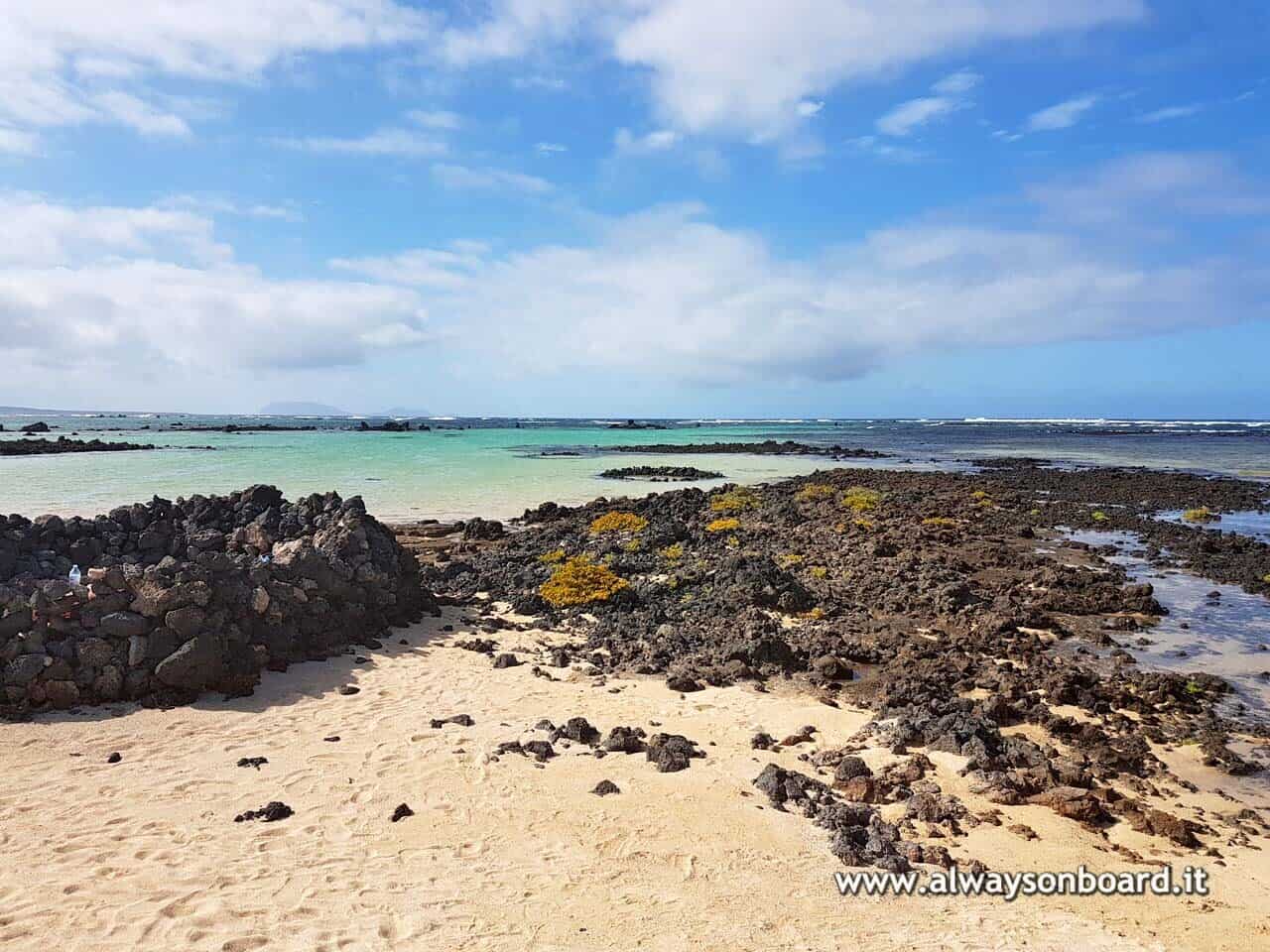
Continue another 1500 meters along the same road, and you will reach Caletòn Blanco.
This beach in Lanzarote, which from the entrance might seem similar to the previous one, is actually completely different. It’s different even in simple photographic terms: it’s impossible to take a photo of this beach that truly does it justice. Every shot makes it look like a different beach with completely different colors.
At Caletòn Blanco, you’ll find a succession of natural pools that tame the power of the ocean waves, leaving the water incredibly clear, almost still, and very warm.
If, once again, you’re lucky enough to have the sun on your side, you will fall in love with this beach: if it’s cloudy, it may seem like a dull grayish landscape, but with the sunlight, you’ll be surrounded by all possible shades of yellow, green, and blue, and you won’t want to leave.
Even at Caletòn Blanco, as in many other areas of the island, you’ll find the typical semi-circular stone constructions to lie down and shelter from the wind, which is often present on the northern side of Lanzarote.
Playa de Famara
Overall rating: 6/10
Services: No
Accessibility: Easy
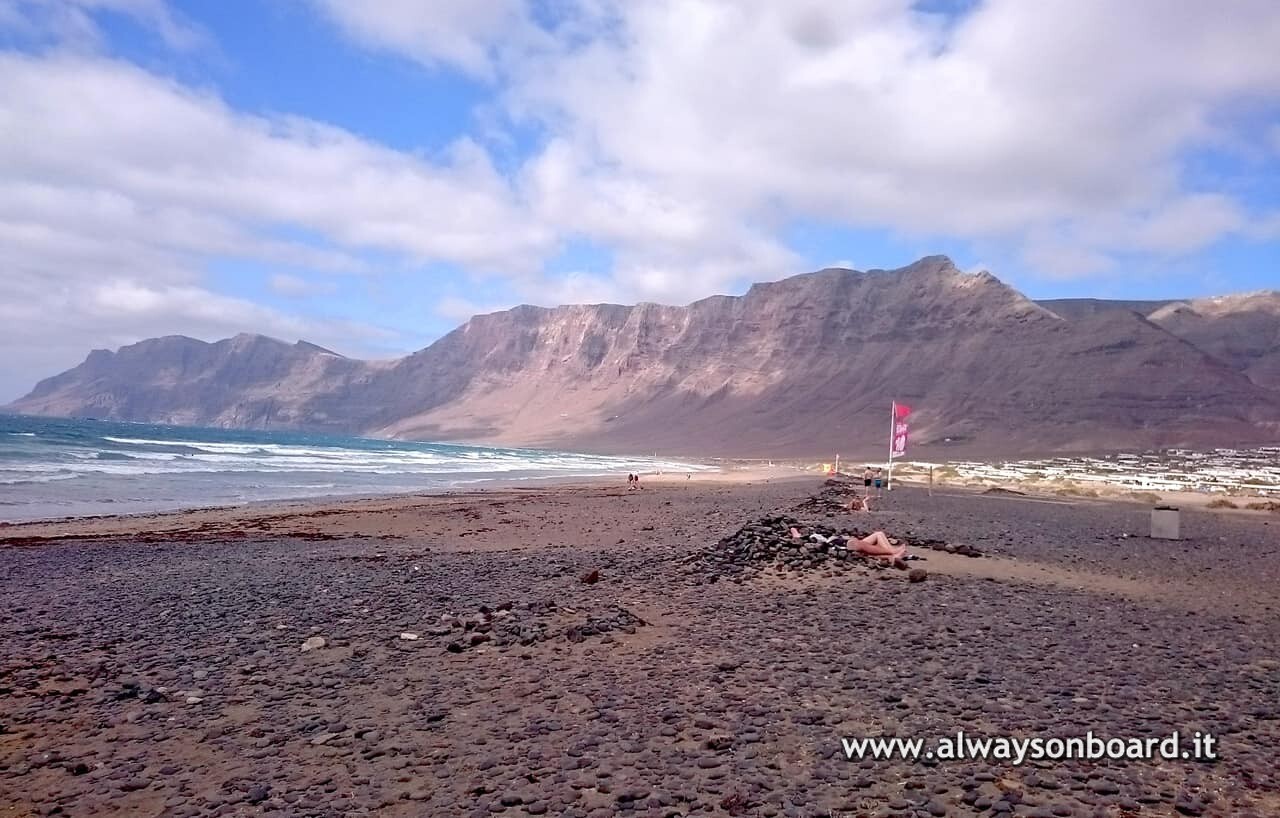
To finish this guide, here’s Playa de Famara, which for some might actually be the first beach in Lanzarote to visit. This imposing beach is indeed the first destination for all surfers or aspiring surfers.
Playa de Famara is a very large beach exposed to the north, where the wind and waves are strong and incessant, thanks to the towering cliffs behind it, some of the tallest on the island.
If you’re looking for relaxation, tanning, or swimming, this is not the beach for you: the wind is strong, and sand is often lifted and ready to get in your eyes. However, it’s a must for anyone who practices surfing or simply wants to spend half an hour admiring the beach and the power of nature.
Here too, my proverbial luck always had me visiting Playa de Famara on cloudy days, so the photo you see may not entirely reflect the panorama you will encounter.
So, after relaxing on these magnificent beaches of Lanzarote, don’t forget to also discover the other things to visit in Lanzarote like the vineyards among the craters.
Did you like this article? Then share it and help me grow the website by following the Facebook page! It will allow you to stay updated with every new article on the Canary Islands! 🙂