Where’s the best place to stay in Tokyo? A question that in Tokyo, more than anywhere else, it’s crucial so you don’t risk ruining your vacation.
Introduction
Before figuring out where’s the best place to stay in Tokyo based on your tastes and needs, there’s an important point about the city of Tokyo.
When choosing where to stay in Tokyo, you might be tempted to think “near the center so I can go out on foot,” like you might do in other cities.
Well, you can forget about that right away, because Tokyo doesn’t really have a proper center and it’s not even a city; rather, it’s a cluster of several different cities with over 9 million inhabitants.
The size of Tokyo’s most “inner” area, which we could define as the area inside the Yamanote Line circle, is so vast that even when looking at the map, you’ll get the impression that crossing a couple of intersections takes 2 minutes, when in reality you have to walk for two km. So, when you look the map, always keep an eye on the “ruler”.
The consequence of all this is that regardless of the area you choose to stay in Tokyo, you’ll walk a lot, even if you don’t want to, because even though Tokyo’s public transport is absolutely punctual, precise, and will take you everywhere thanks to its many lines and stops, the distances are long.
Even the subway stations themselves are sometimes as big as airports; you’ll find yourselves walking 500-800 meters from the entrance stairs to the train doors (I don’t know if I’ve covered more km above or below ground! :lol:).
You may like: Japanese rules and habits you need to know
Requirements for the area to stay in Tokyo
Whatever area you choose to stay in Tokyo, the first two essential requirements for the area where you’ll be staying are these:
- it should be near a stop on the Tokyo Metro (preferably one served by multiple lines) or the Yamanote Line, so you’re not too isolated or waste too much time traveling;
- unless you want to be a hermit in the evening, you’ll need to stay in an area of Tokyo where there’s some evening life; and I don’t necessarily mean hectic nightlife, but at least some restaurants, bars/pubs, or at least a few convenience stores (e.g., 7Eleven) for basic needs, as in some quieter residential areas, you might see everything close as early as 6-7 PM. Also, remember that the subway closes around 11 PM, so if you’re planning on enjoying the nightlife, get accommodation near where you plan to stay out late!
In this guide then, we won’t analyze any single neighborhoods of Tokyo but we’ll see just the best ones you could choose to achieve these goals and to be close to some nightlife.
The best areas to stay in Tokyo
Shinjuku
Shinjuku is probably the most recommended area to stay in Tokyo, and it can satisfy everyone’s tastes.
The Shinjuku area is highly recommended for those who travel around often, thanks to the many subway, train, and Yamanote Line stops in the area. In Shinjuku, you’ll find every type of service, restaurant, bar, or pub, and there’s a good number of markets and convenience stores.
Despite being a very popular area, it’s still very livable and enjoyable even when walking around because road traffic is really light, as it is throughout Tokyo.

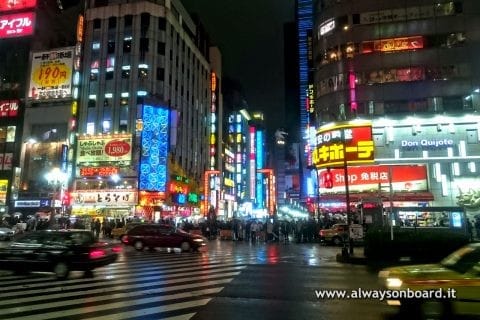
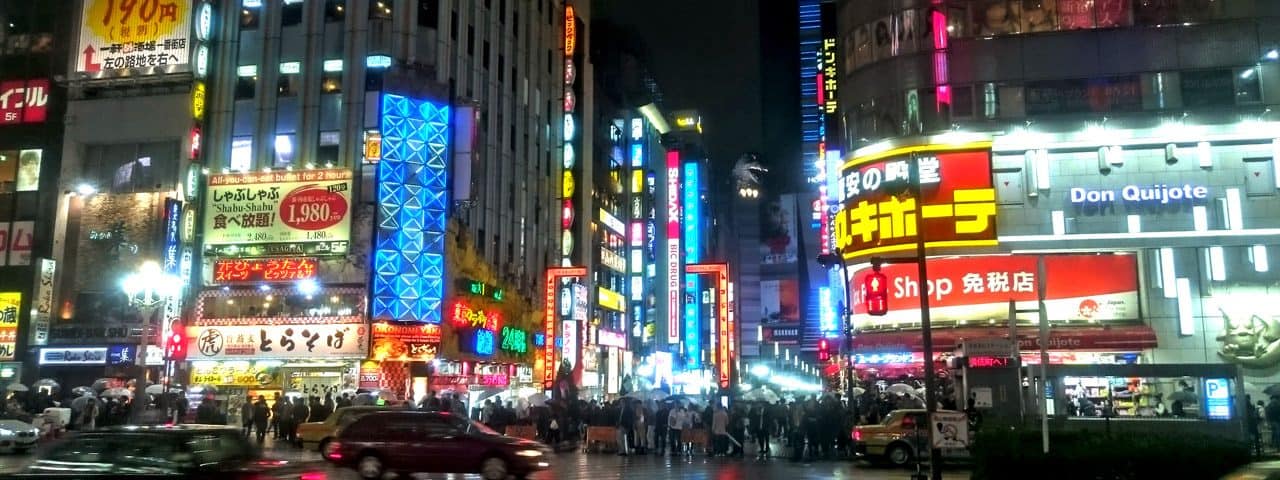
The Shinjuku area is also recommended for staying in Tokyo for those who want to go out at night, thanks to the presence of all kinds of attractions and the famous areas of Kabukicho and Golden Gai.
Kabukicho is known as Tokyo’s “nightlife” district, or sometimes its red-light district; I use quotation marks because it’s not actually as wild as we might think (after all, Tokyo is probably the safest and most orderly city of its size in the world, so even its wild area is a bit tamer 😀 ).

Actually, in Kabukicho, don’t expect big nightclubs or anything like that. The area’s nightlife is mostly made up of Pachinko parlors, which are places where you play a kind of pinball-slot machine hybrid (you can recognize them because they seem quiet from the outside, but as soon as the glass door opens, a strong noise comes out), or some bars, a few “love hotels,” and some Chinese girls (not Japanese) walking around asking if you’re interested in special services outside of rather shady establishments.
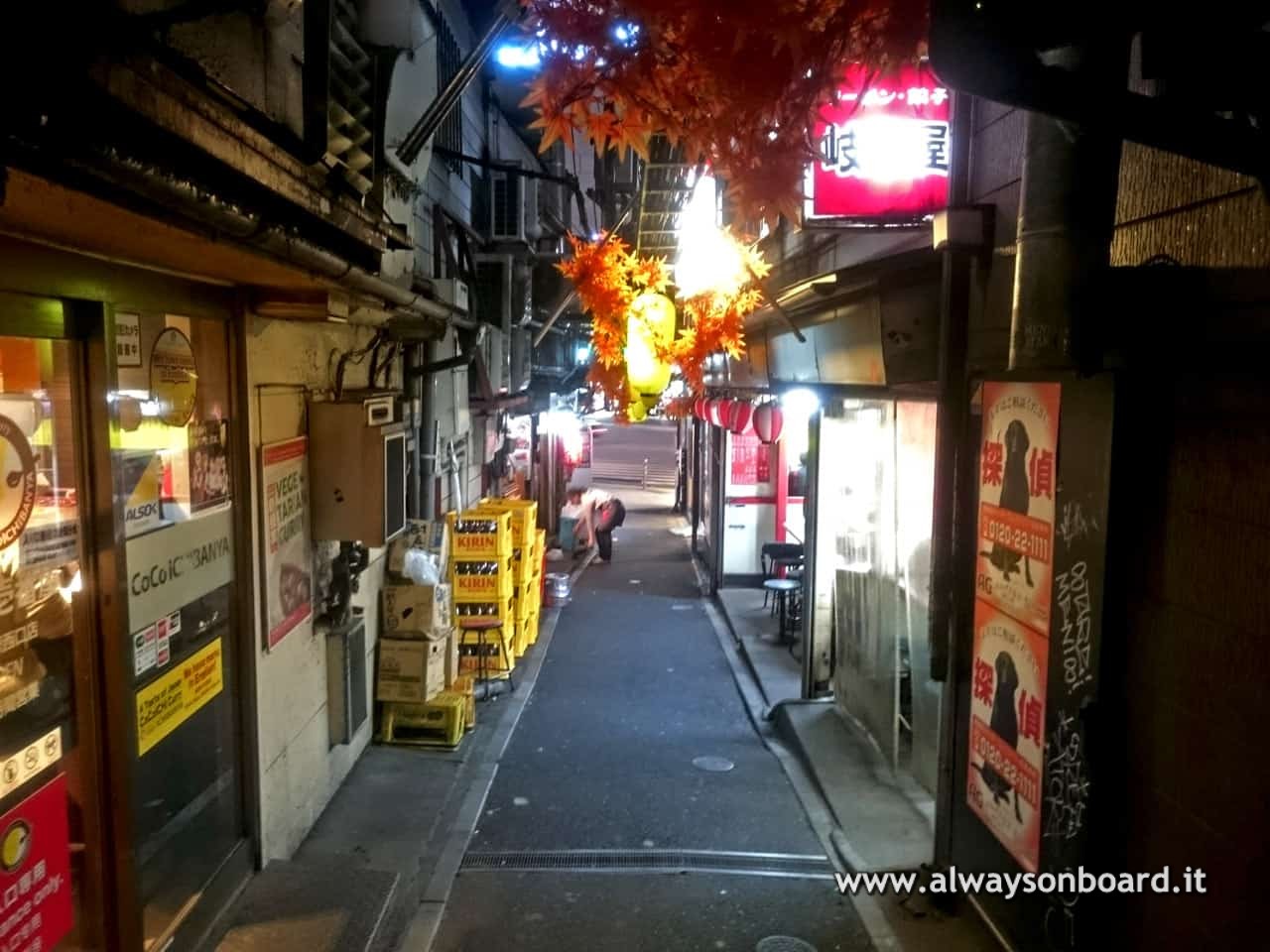
Golden Gai, on the other hand, is a small district (or rather, more like a couple of narrow alleys) dotted with bars and made famous as a destination for drinking and meeting people. Actually, I find it’s more of a tourist trap than anything else, and I don’t particularly recommend it, except for a stroll, since in almost all the tiny bars in Golden Gai you pay a cover charge just to get into the bar (around 8-10€) on top of your drinks, so wasting money is just a matter of moments.
Apart from these, I can say that the rest of the city is absolutely safe (including Shinjuku), to the point where you could walk around day and night with your wallet in hand without any risk.
What I recommend instead is to wander around the Shinjuku area outside of those two districts, because there are lots of pubs and restaurants that are also very nice. The problem is often spotting them, as many are hidden behind a small door or their entrance is on the second (or seventh) floor of some building that from the outside just looks like an office complex.
So, take a look at the map to find them and remember that in Tokyo you always have to look up, since shop signs are often hung on buildings at the level of the floor they’re on! 😀
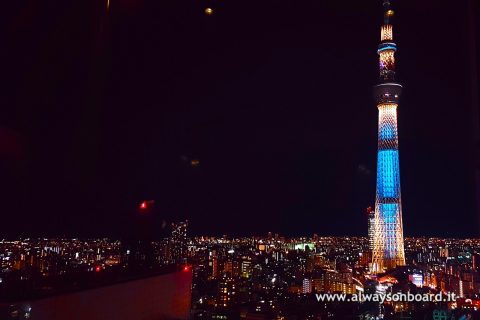
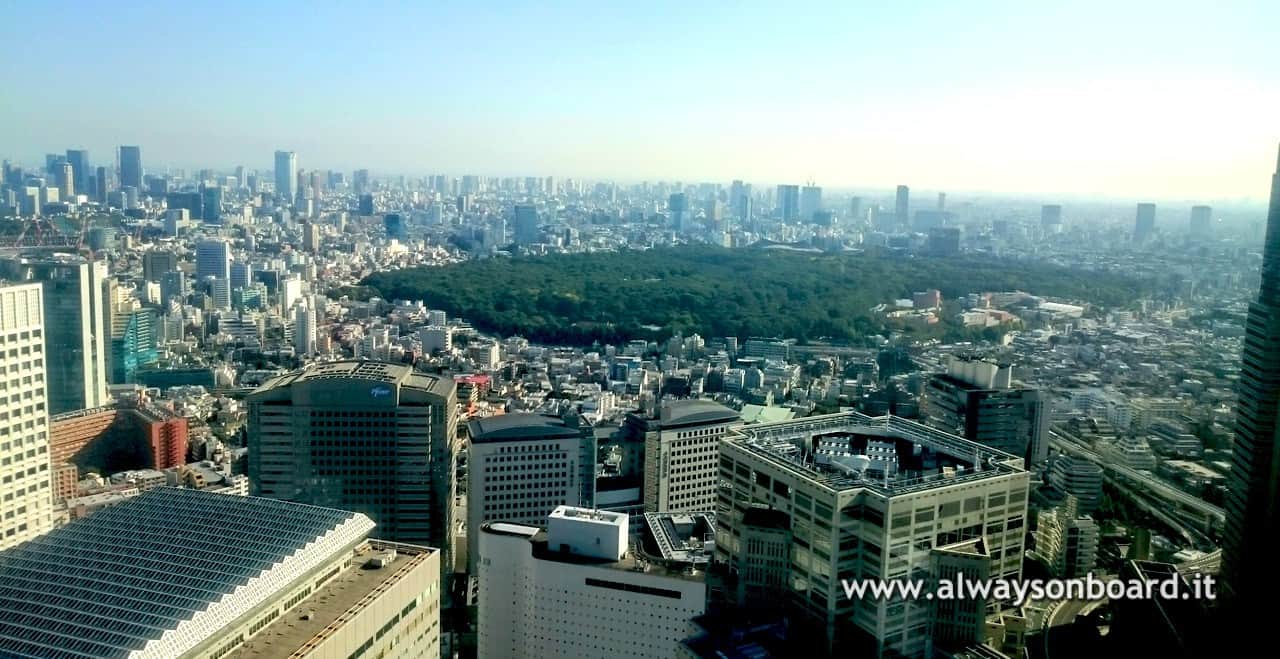
Finally, Shinjuku is also home to the Government Building, one of the tallest buildings in the Japanese capital, where you can go up to the top floor for free to enjoy an endless view of the city: I tell you more about it in detail in this guide to observatories.
A significant aspect of Tokyo is that, despite its extensive urbanization, there’s still a lot of space for large parks, full of ancient and majestic trees, distributed throughout almost all areas of the city. An example in the Shinjuku area is Yoyogi Park, visible from the top of the Government Building, which looks small from up there but is actually almost 2 km in diameter.
- Book and Bed: a rather unique hotel with “library” style interiors, shared bathrooms, free wifi, one of the cheapest in the area;
- Hotel Siena: a relatively cheap 3-star hotel in the Kabukicho area;
- APA Hotel: a good 3-star hotel in the Shinjuku-Gyoenmae area, a few meters from a secondary subway stop, with wifi, SPA, parking, restaurant;
- Hotel Sunroute Plaza Shinjuku: a 4-star hotel in a building near the station at a really competitive price;
- The Knot Tokyo Hotel: hotel with a view of Shinjuku’s government buildings area, which sometimes offers competitive discounts.
Shibuya
Shibuya is another very complete area to stay in Tokyo, similar to Shinjuku that’s right next to it.
Although it’s slightly smaller than Shinjuku, and with a more modest train station, Shibuya is also well-served by the subway, Yamanote Line, and all kinds of services.
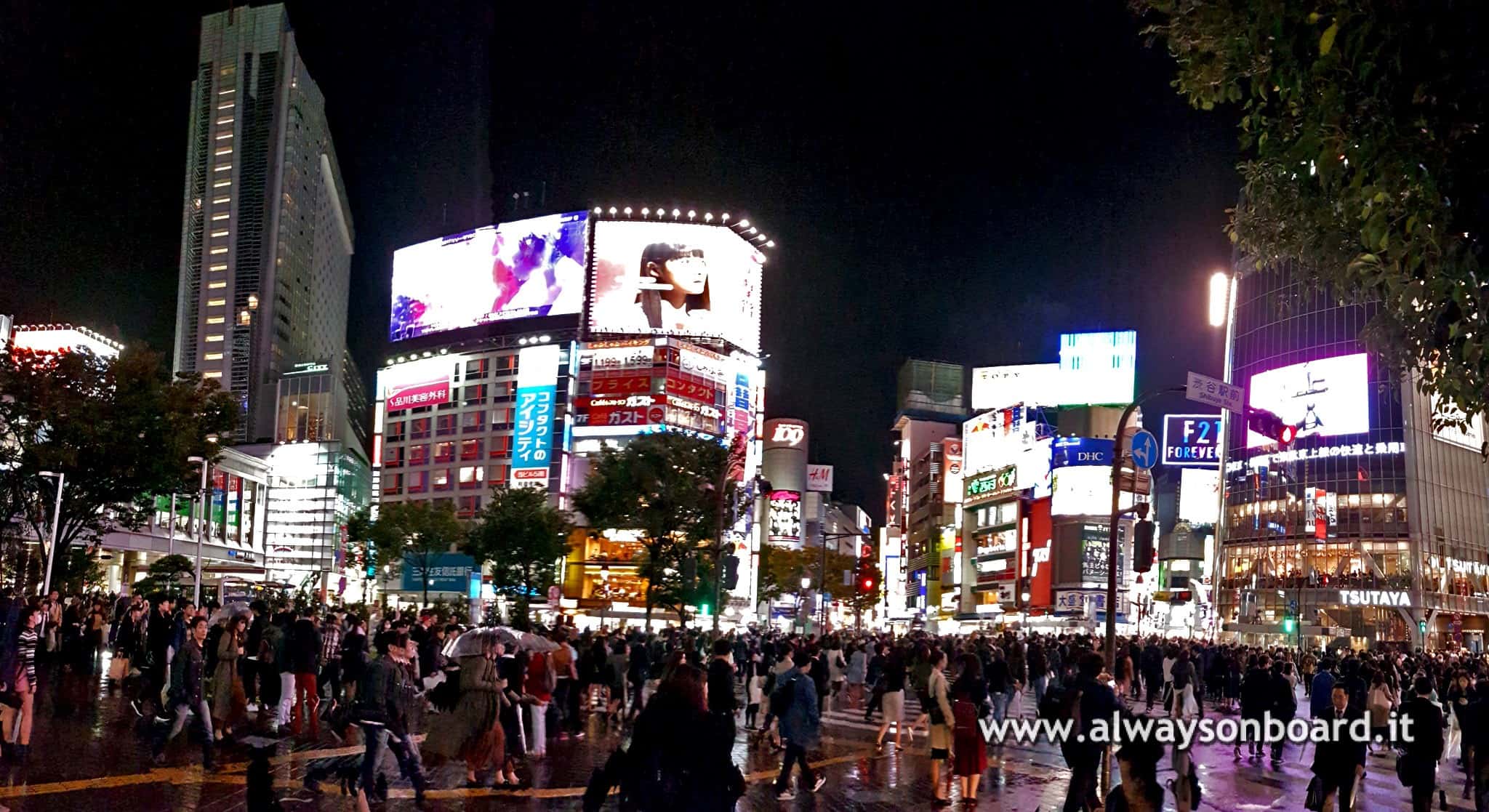
Shibuya has plenty of shopping malls, the world’s busiest (with pedestrians!) and most photographed intersection, and some clubs here and there, which were indeed missing in Shinjuku. If you want to enjoy the nightlife in Shibuya’s clubs, it’s actually better to stay right here, otherwise you’ll have to take a taxi, which isn’t exactly cheap, at the end of the night.
You may like: How much does a trip to Tokyo cost?
So, Shibuya is also a good area to stay in Tokyo for everyone’s tastes, if budget permits; accommodations are in fact a bit more expensive than in Shinjuku.
- Hotel Unizo: a good quality hotel with modern rooms, private bathroom, free wifi, restaurant, 600 meters from the station;
- Shibuya Granbell Hotel: a 3-star hotel with very well-kept Western-style rooms, free wifi, room service available, bar, restaurant, a stone’s throw from the station;
- Tokyu REI Hotel: another 3-star hotel similar to the previous ones, among the cheapest if you can find it available;
- Hotel Sunreon: this is a love hotel (later in this guide you’ll understand what it is) and it doesn’t have very high reviews, but if you’re tight on budget, you could give it a try;
- Stream Excel Tokyu: a 4-star hotel that also has a gym, a stone’s throw from the station and at a price that’s all in all not too far from the previous ones;
Asakusa?
Another famous area in Tokyo is Asakusa, known mainly for Sensoji Temple and the avenue leading up to it, which consists of a long series of stalls with typical products and ornaments, all of which together have become a major tourist attraction. Actually, there’s not much nightlife around here in the evening, and besides the Temple (which is definitely worth a visit), there isn’t much else nearby; it might be worth staying in Asakusa if you find really good deals, otherwise it’s just like any other place.
If you want to stay in the Asakusa area of Tokyo, here you’ll find all available accommodations. When you visit, don’t forget to also try a melonpan!
Accommodation types in Tokyo
Staying in a hotel in Tokyo
Staying in a hotel in Tokyo is probably the most intuitive option, provided you know that hotel rooms are typically very small (7-9 square meters is considered a large room) and usually accommodate a maximum of 1 or 2 people per room.
Pay attention to the type of beds too, as you can easily end up with Japanese-style rooms rather than Western-style ones, where the beds are actually mattresses on the floor (or futons). If this type of bed doesn’t appeal to you, make sure to check the photos or descriptions before booking. Another thing worth checking is the size of the bathroom, especially if you’re tall (or wide); in some hotels and even some apartments, the bathroom literally looks like the inside of a closet.
Staying in a hotel in Tokyo, unfortunately, is also quite expensive; we’re talking about a minimum of 60 euros per night per person, out of peak periods.
Staying in an Airbnb apartment in Tokyo
Although I’m not a fan of Airbnb and similar platforms, this can be the cheapest option to stay in Tokyo if you’re traveling with at least one other person.
By looking for an apartment in Tokyo, you’ll have the chance to save a bit and find accommodations in more central and convenient areas for getting around.
The main advice here (besides the aforementioned check of beds and bathroom) is to try to have a conversation with the owner to make sure you understand each other and to get a contact number in case of problems, as often those who rent on Airbnb don’t even live nearby.
I once had a host who lived in Singapore (and didn’t want to give me a phone number!) who left keys and instructions in mailboxes with codes or combinations. When I arrived, though, the key wasn’t there and the room assigned to me was already occupied by other people. Tracking down the host without a phone number to get a replacement room was a real waste of time.
Staying in a love hotel in Tokyo
Love hotels, which are quite easy to find in Tokyo, could be somewhat generalized as hourly hotels. Love hotels are indeed hotels where you can stay for a few hours or for several days, and they are more geared, in their structure and available services, towards those who go there to spend some intimate time.
In some of them, there isn’t even human staff at the reception, just a machine that handles check-in and key delivery. In the rooms, you might find things like special bath sets, bed sets, DVDs with particular videos, and whatever else on the theme only the Japanese imagination can conceive.
The interesting part about love hotels is that they generally cost less than regular hotels, so if you find one with below-average prices and you’re not embarrassed by the concept, they could be an excellent solution for staying in Tokyo while saving on your budget.
Staying in Capsule Hotels in Tokyo
In Tokyo, as in the rest of Japan, there’s another option for saving some money on accommodation, but it’s only suitable for those who don’t suffer from claustrophobia: Capsule Hotels.
As the name might have already suggested, capsule hotels basically consist of a bed, or rather a mattress, tucked into a “capsule” in a wall (is it too harsh if I call it a cubbyhole?). That’s your entire room and your available space, besides, of course, the shared bathrooms.
If you want to get a better idea of what capsule hotels are like, I recommend checking out this video.
I only recommend staying in a capsule hotel in Tokyo to those who can adapt to anything and need to save on their budget; capsule hotels can typically be found at half the price of a normal hotel (so starting from 30 euros a night).
Alright, now that you know all about where’s best to stay in Tokyo, before you leave, don’t forget to get travel insurance; you’ll be outside Europe, so you’ll need it in case of an emergency! If you don’t know where to start, check out this one.
Did you like this article? Then share it and help me grow the site by following the Facebook page! It’ll allow you to stay updated on every new article about Japan! 🙂